
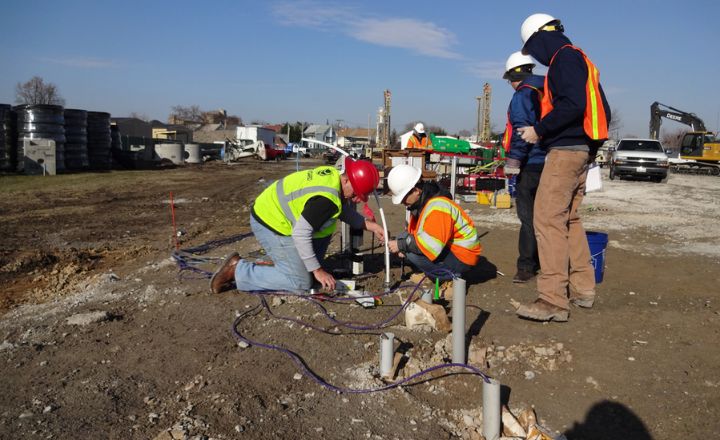
Geotechnical engineering is a specialized branch of civil engineering concerned with the mechanical behavior of soil, rock, and groundwater, and how these earth materials interact with man-made structures.
Geotechnical engineers gather this information through site investigations, borehole drilling, and laboratory testing, then use it to guide decisions on foundation design, earthwork, and ground improvement. In essence, the discipline bridges geology and engineering, ensuring that the ground itself can safely support the structures we build on it.

What Is Geotechnical Engineering?
Geotechnical engineering is the branch of civil engineering focused on how soil, rock, and groundwater behave and interact with structures. Engineers investigate site conditions through borings and lab testing, then use that data to design safe foundations, slopes, retaining walls, tunnels, and other structures that rely on the ground for support.
Electrical Resistivity Imaging (ERI), also known as Electrical Resistivity Tomography (ERT), is a noninvasive geophysical method that has become increasingly important in geotechnical work. We are experts in geotech’s use of ERI. However, we’ll discuss the relationship between the two in a later post. For now, let’s briefly look at the wondrous world of Geotechnical work.
Importance of Geotechnical Engineering
Here’s the importance of geotechnical engineering broken into points:
- Foundation dependency: every structure, regardless of how well it’s designed above ground, ultimately relies on the ground beneath it for stability and support.
- Failure prevention: without proper understanding of soil and rock conditions, foundations can fail, buildings can settle unevenly or crack, and slopes can collapse.
- Disaster mitigation: it plays a critical role in preventing landslides, sinkholes, and earthquake-induced soil liquefaction.
- Safer, smarter design: it guides the design of foundations, retaining structures, tunnels, and dams, making them both safer and more economical.
- Economic benefits: accurately assessing ground conditions early on helps avoid expensive redesigns, construction delays, and costly structural failures later.
- Foundational role in infrastructure: in essence, geotechnical engineering provides the literal and figurative foundation for nearly all construction and infrastructure projects.
History of Geotechnical Engineering
Geotechnical engineering traces its roots back to ancient civilizations. The Egyptians and Romans applied basic soil compaction and foundation techniques without any formal theory behind them, relying largely on experience and trial and error. This pre-scientific approach sometimes led to notable failures, such as the Leaning Tower of Pisa, which began tilting due to an inadequate understanding of the soft, uneven soil beneath it.
- The field started gaining scientific footing in the 18th century when French engineer Charles-Augustin de Coulomb developed early theories on soil shear strength and earth pressure. His work was later expanded in the 19th century by William Rankine, as growing industrialization and large infrastructure projects like railways and canals demanded more rigorous ground analysis.
- The true turning point came in the 1920s with Karl von Terzaghi, often called the father of soil mechanics. He introduced the concept of effective stress and developed systematic methods for analyzing soil behavior, settlement, and bearing capacity, transforming geotechnical engineering into a proper scientific discipline.
- By the mid-20th century, the field had become formally recognized within civil engineering, with universities establishing dedicated courses and research programs. Since then, advancements in computer modeling, advanced testing methods, and seismic understanding, particularly around soil liquefaction, have allowed engineers to design increasingly complex structures, from skyscrapers to offshore platforms and underground transit systems.
Soil Mechanics
Soil mechanics is the scientific study of soil’s physical and mechanical behavior, particularly how it deforms and responds to stress, water, and time.
It covers fundamental concepts such as effective stress (developed by Terzaghi), which separates the stress carried by soil particles from that carried by pore water; consolidation, the process by which soil compresses over time as water is squeezed out under load; and shear strength, which determines how much load soil can resist before it fails.
These principles form the analytical foundation for nearly every other geotechnical topic, from foundation design to slope stability.
Rock Mechanics
Rock mechanics examines how intact rock and rock masses (rock plus the discontinuities like joints, fractures, and faults within it) behave under stress. Unlike soil, rock strength is heavily influenced by these discontinuities, which can create planes of weakness even in otherwise strong material.
Rock mechanics is critical for designing tunnels, underground caverns, rock slopes, dam foundations, and mining excavations, where engineers must assess rock quality, joint orientation, and the potential for block failure or rockfall.
Site Investigation
Site investigation is the systematic process of exploring subsurface conditions before design begins. It typically progresses through desk studies (reviewing geological maps and historical records), followed by drilling boreholes to collect soil and rock samples at various depths, and in-situ testing to measure properties directly in the ground.
The data gathered, soil layering, groundwater depth, rock quality, and material properties, forms the basis for all subsequent geotechnical design decisions, making this arguably the most critical step in any project.
Soil Classification
Soil classification systems organize soils into categories based on measurable characteristics like grain size distribution, plasticity, and organic content.
The most widely used system, the Unified Soil Classification System (USCS), divides soils into groups such as gravels, sands, silts, and clays, further refined by symbols like CL (low-plasticity clay) or SW (well-graded sand). Classification allows engineers to quickly estimate a soil’s likely engineering behavior, such as drainage characteristics and compressibility, based on established correlations.
you can explore in this artical: industrial engineering
Soil Properties
Soil properties are the measurable characteristics that govern how soil behaves under load and water flow. Key properties include unit weight (density), water content, void ratio and porosity, permeability (how easily water flows through it), shear strength (resistance to sliding failure), and compressibility (how much it deforms under load).
These properties vary widely between soil types, sands tend to be more permeable but less compressible, while clays are often less permeable but more prone to long-term settlement.
Foundation Engineering
Foundation engineering focuses on designing the interface between a structure and the ground, ensuring loads are transferred safely without excessive settlement or failure.
It requires integrating knowledge of soil properties, bearing capacity, and settlement behavior to select the most appropriate and economical foundation type for a given site and structure, balancing safety, cost, and constructability.
Shallow Foundations
Shallow foundations transfer loads to soil layers relatively close to the ground surface, generally where the depth is less than the foundation’s width.
Common types include isolated spread footings (supporting individual columns), combined footings, and mat or raft foundations (a single slab supporting an entire structure). They’re typically used when near-surface soils are strong and stable enough to support the structure without significant settlement.
Deep Foundations
Deep foundations transfer loads to deeper, stronger soil or rock layers when surface soils are too weak, compressible, or unstable. Common types include driven or bored piles, drilled shafts, and caissons.
They work either through end bearing (resistance at the pile tip) or skin friction (resistance along the pile’s sides), or a combination of both, and are common in high-rise buildings, bridges, and structures on soft or loose ground.
Bearing Capacity of Soil
Bearing capacity is the maximum pressure soil can support before undergoing shear failure beneath a foundation.
Engineers calculate ultimate bearing capacity using theories developed by researchers like Terzaghi and Meyerhof, which account for factors like soil cohesion, friction angle, foundation depth and width, and groundwater conditions. A safety factor is then applied to determine the allowable bearing capacity used in design.
Settlement of Foundations
Settlement refers to the vertical movement of a foundation as soil beneath it compresses under load. It’s generally divided into immediate settlement (occurring quickly upon loading), consolidation settlement (occurring slowly as water drains from clay soils), and secondary compression (very slow, long-term settlement).
Excessive or uneven settlement can cause structural cracking, tilting, or functional problems, so predicting it accurately is essential to foundation design.
Slope Stability
Slope stability analysis evaluates whether a natural or constructed slope will remain stable or is at risk of failure (landsliding).
Engineers calculate a factor of safety by comparing the forces resisting failure (like soil shear strength) against the forces driving failure (like gravity and water pressure). Factors influencing stability include slope angle, soil type, groundwater levels, and external loads, and analysis methods range from simple limit equilibrium methods to advanced computer modeling.
Earth Retaining Structures
Earth retaining structures hold back soil to prevent collapse, erosion, or unwanted movement, allowing for changes in ground elevation. Common types include gravity retaining walls, cantilever walls, sheet pile walls, and mechanically stabilized earth (MSE) walls reinforced with geosynthetics or metal strips.
Design requires calculating lateral earth pressures, which depend on soil properties, wall geometry, and drainage conditions.
Ground Improvement Techniques
Ground improvement techniques modify weak, loose, or problematic soils to make them more suitable for construction, often as a more economical alternative to deep foundations.
Methods include compaction (densifying soil with mechanical energy), preloading or surcharging (accelerating consolidation), grouting (injecting materials to fill voids or strengthen soil), and installing stone columns or soil-cement mixing to improve strength and reduce settlement potential.
Geotechnical Testing
Geotechnical testing encompasses all the methods used to measure soil and rock properties needed for design, broadly divided into laboratory tests (on extracted samples) and field tests (conducted in-situ).
Testing provides the quantitative data, strength, compressibility, permeability, density, that feeds directly into foundation design, slope stability analysis, and risk assessments.
Laboratory Soil Tests
Laboratory tests are performed on soil samples under controlled conditions to measure specific properties. Key examples include the triaxial test (measuring shear strength under various confining pressures), the consolidation (oedometer) test (measuring compressibility and settlement behavior), the direct shear test, and Atterberg limits tests (determining plasticity characteristics).
These tests offer precise, repeatable measurements but may not perfectly capture in-situ conditions.
Field Soil Tests
Field tests are conducted directly at the site to assess soil behavior in its natural, undisturbed state.
Common examples include the Standard Penetration Test (SPT), which measures resistance to a driven sampler and correlates to soil density and strength; the Cone Penetration Test (CPT), which provides continuous, detailed subsurface profiles; and the vane shear test, often used for soft clays. Field tests are especially valuable for soils that are difficult to sample intact, like loose sands.
Groundwater Effects
Groundwater significantly influences soil behavior through pore water pressure, which reduces the effective stress holding soil particles together and thus its strength.
High groundwater levels can increase lateral pressures on retaining structures, cause seepage and erosion, reduce bearing capacity, and, during seismic events, trigger liquefaction in saturated, loose, sandy soils. Managing groundwater through drainage, dewatering, or barriers is often a critical part of geotechnical design.
Geotechnical Hazards
Geotechnical hazards are ground-related risks that threaten structures and safety.
These include landslides (slope failures, often triggered by rainfall or earthquakes), sinkholes (collapse due to dissolution of underlying rock or void formation), liquefaction (loss of soil strength during earthquakes), and subsidence (gradual sinking of the ground, often from groundwater extraction or mining). Identifying and mitigating these hazards is a key responsibility of geotechnical engineers.
Applications of Geotechnical Engineering
Geotechnical engineering applies to virtually every type of construction project.
This includes building foundations, highway and railway subgrades, dams and levees, tunnels and underground structures, ports and offshore platforms, landfills and waste containment systems, and renewable energy infrastructure like wind turbine foundations, anywhere a structure interacts meaningfully with the ground.
Role of Geotechnical Engineer
A geotechnical engineer is responsible for investigating subsurface conditions, interpreting test data, and designing safe, economical solutions for foundations, slopes, and earth retaining structures.
Their work bridges fieldwork, laboratory analysis, and design, often requiring collaboration with structural engineers, geologists, and contractors throughout a project’s planning, design, and construction phases.
Future of Geotechnical Engineering
Advances in computational modeling are shaping the future of the field (allowing more complex and accurate simulations of soil-structure interaction), remote sensing and satellite monitoring for large-scale hazard detection, smart sensors for real-time monitoring of structures and slopes,
and growing emphasis on sustainability, such as designing for climate change impacts like rising sea levels, increased rainfall, and more frequent seismic events.
Conclusion
Geotechnical work is essential to civil engineering and ensures construction projects’ safety, stability, and sustainability. From designing foundations and retaining walls to assessing seismic risks and remediating contaminated sites, geotechnical engineers provide the expertise to manage the interaction between the earth and manufactured structures effectively.