

Artificial Intelligence (AI) is transforming cybersecurity by enabling faster threat detection, automated security responses, and advanced analysis of large amounts of data. Unlike traditional security methods, AI-powered systems can identify and respond to cyber threats in real time, helping organizations reduce risks more efficiently.
AI improves the security of endpoints, networks, and cloud environments through technologies such as phishing detection, behavioral monitoring, vulnerability assessment, and secure authentication systems.
AI-driven cybersecurity also minimizes manual workload and reduces human errors, allowing security teams to respond more quickly and improve overall protection.
Successful implementation of AI in cybersecurity depends on accurate data, continuous model training, regular updates, human supervision, and smooth integration with existing security systems. However, AI-based security solutions also introduce new risks, including adversarial attacks and data poisoning, making it essential for organizations to adopt adaptive and continuously evolving defense strategies.
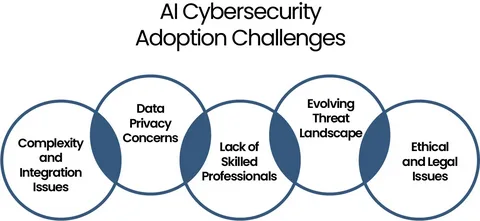
Artificial Intelligence (AI) in cybersecurity involves the use of advanced algorithms and machine learning technologies to improve the detection, prevention, and response to cyber threats. AI-based security systems can process and analyze massive amounts of data, recognize suspicious patterns, and make accurate decisions much faster than traditional human-driven methods.
AI plays an important role in strengthening cybersecurity by automating routine tasks such as vulnerability assessments, log monitoring, and security analysis. This automation allows cybersecurity professionals to concentrate on more advanced and strategic responsibilities. AI-powered tools are also highly effective in real-time threat detection, helping organizations quickly identify and respond to potential attacks before serious damage occurs.
In addition, AI systems continuously learn and improve from new data, allowing them to adapt to evolving cyber threats and attack methods. AI-driven cybersecurity enhances threat detection, automates incident response, improves vulnerability management, and supports proactive defense strategies. By monitoring user behavior, identifying phishing attempts, and detecting abnormal activities, AI helps organizations protect sensitive information and maintain stronger overall security.
How can AI help prevent cyberattacks?
The Shift Toward AI-Native Cybersecurity
The cybersecurity industry is rapidly moving toward AI-native defense systems. According to Gartner, by 2026 more than 60% of organizations are expected to use cybersecurity platforms powered by AI-enhanced automation, compared to less than 20% in 2023. This rapid growth shows that AI-driven security is no longer considered an optional or advanced feature but has become an essential requirement for protecting organizations against fast and sophisticated cyber threats.
- AI strengthens cyber threat intelligence by helping security professionals identify, analyze, and respond to cyberattacks more efficiently. AI-powered systems can process enormous amounts of data to detect suspicious patterns, indicators of compromise, unusual login attempts, abnormal network behavior, and malicious activity from IoT devices or endpoints in real time. By understanding behavioral patterns and network activities, AI helps organizations recognize potential attacks at very early stages.
- AI also improves cybersecurity defenses by continuously monitoring systems, isolating compromised devices, blocking harmful traffic, and preventing malware infections before they spread. In addition, AI can predict high-risk vulnerabilities and identify weak areas within networks, allowing organizations to take proactive security measures before serious breaches occur.
Another major advantage of AI in cybersecurity is advanced user authentication. AI-based tools can analyze fingerprints, typing behavior, voice recognition, and user activity patterns to verify identities and detect suspicious actions during active sessions. If unusual behavior is detected, the system can automatically trigger additional security verification.
AI also supports threat attribution by analyzing attack methods, IP addresses, malware behavior, and digital footprints to connect cyber incidents with known threat actors or hacking groups. This helps security teams better understand attackers and improve defensive strategies.
Furthermore, AI significantly enhances phishing and spam detection by scanning email attachments, messages, and malicious links before they can harm systems or users. AI-driven collaboration also allows organizations to share threat intelligence across security communities, improving collective protection against evolving AI-powered cyber threats, especially in large-scale cloud infrastructures and AI data centers where security challenges continue to grow.
Is it safe to automate cybersecurity?
Modern cybersecurity still depends heavily on human involvement, but many routine tasks such as system monitoring, threat detection, and incident response can now be automated using Artificial Intelligence (AI).
AI-powered automation helps organizations improve their threat intelligence capabilities by quickly identifying new and evolving cyber threats while reducing the time required for manual security analysis. This has become increasingly important as cyberattacks continue to grow more advanced and sophisticated.
- AI-driven cybersecurity automation is considered reliable because it is already widely used in different business operations. For example, departments such as Human Resources (HR) and Information Technology (IT) use AI systems to automate employee onboarding, manage access permissions, and provide resources efficiently. Similar automation techniques are now being applied to cybersecurity operations to strengthen protection and improve efficiency.
- Automation is especially valuable because many organizations face a shortage of skilled cybersecurity professionals. AI allows companies to strengthen security operations without depending entirely on additional human experts. This helps businesses maximize their security investments and maintain effective protection with fewer operational challenges.
- One major advantage of AI automation in cybersecurity is cost efficiency. AI enables faster data collection, quicker incident response, and more effective threat management. By automating repetitive and time-consuming tasks, cybersecurity professionals can focus on strategic planning, risk management, and advanced security operations that provide greater value to organizations.
Another important benefit is the reduction of human error. Traditional cybersecurity systems often rely on manual processes, where mistakes can lead to security breaches or operational failures. AI reduces the need for constant human intervention, making security operations more accurate, consistent, and efficient. Organizations can also allocate human resources to areas where critical thinking and expertise are most needed.
AI automation also improves decision-making by helping organizations identify weaknesses and vulnerabilities in their security strategies. Automated systems can analyze security data, detect deficiencies, and support the implementation of stronger and more structured cybersecurity procedures, resulting in safer and more reliable IT environments.
Despite these advantages, organizations must also recognize the growing risks associated with AI-driven cybercrime.
Cybercriminals are increasingly using AI technologies to create more advanced attacks, bypass security defenses, and develop sophisticated malware capable of targeting both traditional systems and AI-enhanced cybersecurity infrastructures. As a result, cybersecurity strategies must continuously evolve to counter emerging AI-powered threats effectively.
Key applications of AI in cybersecurity
1. Password Protection and User Authentication
Artificial Intelligence (AI) plays an important role in improving password security and user authentication systems. Modern organizations use AI-powered technologies such as CAPTCHA verification, facial recognition, fingerprint scanning, and biometric authentication to confirm whether login attempts are genuine or potentially harmful.
These advanced security methods help protect sensitive user information and prevent unauthorized access to accounts and networks.
AI-based authentication systems are highly effective against cyber threats such as brute-force attacks and credential stuffing, where attackers attempt to gain access using stolen usernames and passwords. By automatically analyzing login behavior and identifying suspicious activities, AI strengthens account security and reduces the risk of cyber intrusions.
2. Phishing Detection and Prevention
Phishing attacks continue to be one of the most common cybersecurity threats affecting businesses and individuals. AI-powered email security solutions help organizations detect malicious emails by analyzing their content, context, and communication patterns.
These systems can quickly identify suspicious characteristics such as fake senders, email spoofing, harmful attachments, and misspelled domain names.
Machine Learning (ML) enables AI systems to continuously learn from previous attacks and improve detection accuracy over time. AI can also study how users normally communicate and recognize unusual behavior or deceptive language patterns.
This capability is especially useful for identifying sophisticated attacks such as spear phishing, where attackers impersonate executives or trusted individuals to steal sensitive information. AI systems can intercept these threats before they damage corporate networks or compromise valuable data.
3. Vulnerability Management
Cybercriminals constantly develop new attack techniques, leading to the discovery of thousands of new software and network vulnerabilities every year. Managing these vulnerabilities manually is difficult and time-consuming for organizations. AI-powered cybersecurity solutions help businesses identify, analyze, and prioritize security weaknesses more effectively.
Technologies such as User and Entity Behavior Analytics (UEBA) allow AI systems to monitor the activities of users, servers, applications, and devices to detect unusual or suspicious behavior.
AI can identify potential zero-day attacks and previously unknown vulnerabilities even before official security patches become available. This proactive approach helps organizations strengthen their defenses and reduce the risk of cyberattacks.
4. Network Security
AI significantly improves network security by helping organizations monitor traffic patterns, manage policies, and detect malicious activities across complex networks. Traditional network security often requires large amounts of manual effort to create rules and identify legitimate connections. AI automates many of these processes and improves the accuracy of threat detection.
AI systems learn normal network behavior over time and can recognize unusual traffic, unauthorized access attempts, or suspicious workloads.
This helps organizations apply security policies more efficiently and supports advanced security models such as zero-trust architecture, where every connection must be verified before access is granted. AI also assists security teams in organizing applications and workloads more effectively, reducing operational complexity.
5. Behavioral Analytics
Behavioral analytics uses AI to study user behavior, device activities, and application usage patterns to identify potential cyber threats. Traditional cybersecurity systems mainly rely on known attack signatures and indicators of compromise (IOCs), but modern cyberattacks evolve too quickly for these methods alone to remain effective.
AI-powered behavioral analytics creates detailed profiles of normal user and system activities by processing large volumes of data. Incoming activities are then compared against these profiles to identify anomalies or unusual behavior that may indicate malicious actions.
This allows organizations to detect insider threats, compromised accounts, unauthorized access, and emerging cyberattacks at early stages, improving overall threat-hunting and incident response capabilities.
Top AI-powered cybersecurity tools
Modern enterprise cybersecurity requires advanced tools capable of operating at machine speed, analyzing massive amounts of threat data, and providing actionable intelligence without placing excessive pressure on security teams.
AI-powered cybersecurity solutions fulfill these requirements by improving the accuracy of threat detection, automating incident response processes, minimizing false positive alerts, and enhancing the overall security posture of organizations across all layers of their digital environments.

Artificial Intelligence enables security systems to rapidly identify suspicious activities, analyze complex attack patterns, and respond to threats much faster than traditional security methods. Automated incident response workflows help organizations contain and mitigate cyberattacks efficiently while reducing the manual workload on cybersecurity professionals.
AI also helps reduce false positives by distinguishing genuine threats from harmless activities, allowing security teams to focus on critical incidents more effectively.
In addition, AI-driven cybersecurity strengthens protection across networks, endpoints, cloud systems, applications, and user environments. By continuously monitoring systems and adapting to emerging threats, AI helps organizations maintain stronger, more proactive, and resilient security infrastructures capable of defending against modern cyber risks.
1. AI-Powered Endpoint Security Solutions
AI-powered endpoint security solutions protect devices such as laptops, desktops, and mobile phones from cyber threats like malware and ransomware.
These systems monitor device activities in real time and use deep learning technologies to detect suspicious behavior and stop zero-day attacks before they execute. This helps organizations strengthen endpoint protection and reduce security risks.
2. AI-Based Next-Generation Firewalls (NGFW)
AI-powered Next-Generation Firewalls (NGFWs) provide advanced network security by detecting and blocking cyber threats before they reach important systems. These firewalls perform deep-packet inspection, intrusion prevention, and application control to identify both known and unknown attacks. AI improves firewall efficiency by analyzing traffic patterns and responding to threats automatically.
3. Security Information and Event Management (SIEM)
AI-powered Security Information and Event Management (SIEM) solutions collect and analyze security data from across an organization’s environment. AI helps automate alert analysis, reduce false positives, and identify real cyber threats more accurately. This enables security teams to respond faster and improve overall incident management.
4. AI-Driven Cloud Security Solutions
AI-driven cloud security solutions monitor cloud environments to identify security risks such as misconfigurations, unauthorized access, and suspicious data activities. These systems help organizations maintain consistent protection and enforce compliance across multiple cloud platforms while improving visibility into cloud-based operations.
5. AI-Powered Network Detection and Response (NDR) Solutions
AI-powered Network Detection and Response (NDR) solutions monitor network traffic to detect hidden threats and suspicious activities that traditional security tools may miss. AI analyzes communication patterns and identifies abnormal behavior, enabling organizations to stop attacks and respond automatically before significant damage occurs.
How AI optimizes security operations in real time?
Modern cyber threats are evolving at an extremely fast pace, making rapid incident response more important than ever.
According to the Fortinet FortiGuard Labs 2025 Cyberthreat Predictions report, newly discovered vulnerabilities are now exploited within an average of only 4.76 days, representing a significant increase in attack speed compared to previous years. This highlights the urgent need for organizations to strengthen their cybersecurity response capabilities.
Winning the Mean-Time-to-Respond (MTTR) Race
Artificial Intelligence (AI) plays a critical role in improving Mean-Time-to-Respond (MTTR) by automating threat detection, accelerating incident response processes, and reducing the workload on security analysts.
AI-powered systems continuously monitor network traffic, analyze security events, correlate threat indicators, and prioritize alerts based on the severity of risks. This allows security teams to respond to high-priority threats more quickly and efficiently.
AI also enhances cybersecurity through advanced practices such as red teaming and purple teaming. AI-powered red teaming simulates real-world cyberattacks to identify weaknesses and vulnerabilities before attackers can exploit them.
Purple teaming combines offensive testing methods with defensive security operations, helping organizations improve detection capabilities, strengthen response strategies, and refine incident response playbooks. Together, these AI-driven approaches create a more proactive, resilient, and adaptive cybersecurity posture capable of defending against rapidly evolving cyber threats.
How can generative AI be used in cybersecurity?
Generative Artificial Intelligence (Generative AI) is transforming cybersecurity by helping organizations create smarter, faster, and more adaptive defense systems. Unlike traditional AI models that mainly analyze data, generative AI can create new data that closely resembles real-world information.
This capability makes it highly valuable for improving cybersecurity strategies, threat detection, and defense preparedness against modern cyber threats.
Realistic Cyberattack Simulations
Generative AI can create highly realistic cyberattack simulations that allow security teams to test their defense systems and incident response plans in controlled environments. These simulations imitate real-world threats such as ransomware attacks, phishing campaigns, and network intrusions.
By practicing against simulated attacks, organizations can identify vulnerabilities, improve preparedness, and strengthen their overall cybersecurity defenses before real attacks occur.
Predicting Future Attack Scenarios
Generative AI can analyze large volumes of historical cyberattack data and security incidents to identify patterns, trends, and emerging threats.
This predictive capability helps organizations anticipate potential attack scenarios and implement preventive security measures in advance. By staying ahead of cybercriminal tactics, businesses can reduce risks and improve their overall threat intelligence strategies.
Enhancing Threat Detection Systems
Generative AI improves threat detection by generating synthetic data that closely resembles real-world attack behavior. This additional training data strengthens machine learning models and improves their ability to identify subtle, unknown, or advanced cyber threats.
As a result, AI-powered systems become more effective at detecting malware, phishing attempts, suspicious activities, and evolving attack techniques.
Strengthening Proactive Cyber Defense
Generative AI supports proactive cybersecurity by enabling organizations to continuously improve their defense strategies and adapt to rapidly changing cyber threats.
Through intelligent simulations, predictive analytics, and advanced detection capabilities, AI helps cybersecurity professionals respond more quickly, reduce security risks, and build stronger and more resilient digital infrastructures.
Benefits of artificial intelligence (AI) in managing cyber risks
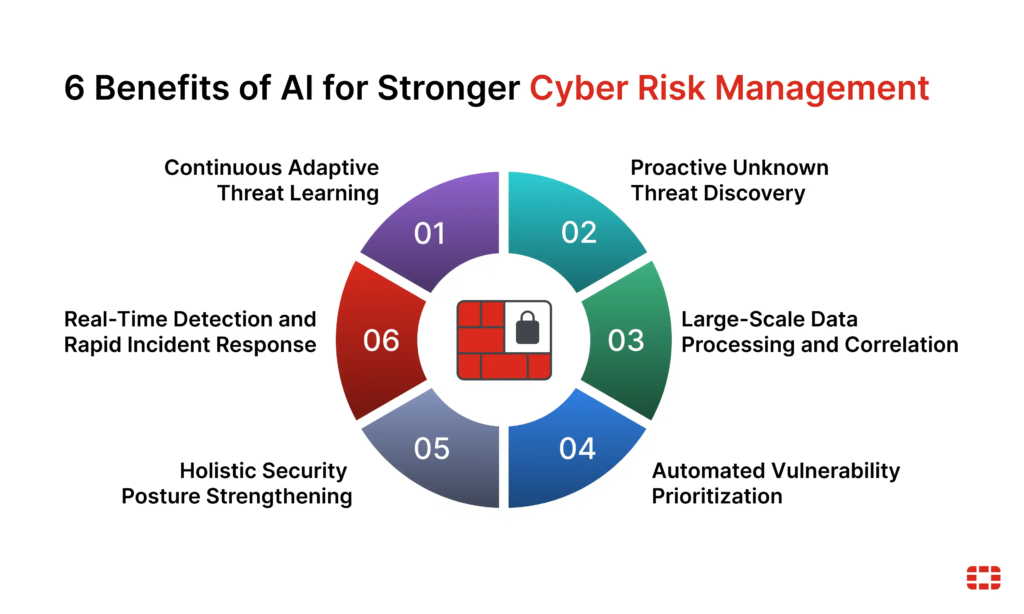
Implementing AI in cybersecurity offers a wide range of benefits for organizations looking to manage their risk. Typical benefits are:
Ongoing Learning and Adaptation
One of the biggest advantages of implementing Artificial Intelligence (AI) in cybersecurity is its ability to learn continuously from new data and evolving threats. Technologies such as Machine Learning (ML) and deep learning allow AI systems to recognize patterns, establish normal behavior baselines, and identify unusual or suspicious activities that may indicate cyberattacks. As AI systems constantly improve through ongoing learning, it becomes increasingly difficult for cybercriminals to bypass organizational security defenses.
Discovering Unknown Threats
Modern cybercriminals continuously develop advanced attack techniques and sophisticated attack vectors that traditional security systems may fail to detect. AI helps organizations identify and prevent unknown threats, including vulnerabilities that have not yet been officially discovered or patched by software providers. This proactive capability enables organizations to strengthen their cybersecurity posture and reduce the risk of emerging attacks causing significant damage to networks and systems.
Managing Vast Volumes of Data
AI-powered cybersecurity systems can process and analyze enormous amounts of security data, network traffic, and system logs far more efficiently than human analysts alone. Traditional security tools often struggle to identify hidden threats within large datasets, but AI can automatically detect suspicious patterns and anomalies in real time. This allows organizations to discover potential cyber threats more quickly and improve overall monitoring capabilities across complex digital environments.
Improved Vulnerability Management
AI also enhances vulnerability management by helping organizations identify, assess, and prioritize security weaknesses more effectively. AI systems can continuously evaluate networks, devices, and applications to detect weak points and recommend corrective actions. This improves decision-making, strengthens problem-solving capabilities, and ensures that security teams remain focused on the most critical cybersecurity risks and vulnerabilities.
Enhanced Overall Security Posture
Managing a wide range of cyber threats manually, including phishing attacks, ransomware, malware, and denial-of-service (DoS) attacks, can be extremely difficult and time-consuming. AI improves overall cybersecurity by enabling organizations to detect threats in real time, prioritize risks intelligently, and respond more efficiently to security incidents. Continuous monitoring and automated analysis help organizations maintain stronger, more proactive, and resilient security infrastructures.
Better Threat Detection and Faster Response
Threat detection and rapid response are essential components of modern cybersecurity. AI-enabled security systems can quickly identify suspicious or untrusted activities and respond systematically to minimize potential damage. Automated detection and response capabilities reduce the time required to contain cyber threats, improve incident management, and help organizations protect sensitive data, systems, and digital assets more effectively.
5 key challenges and risks of AI in cybersecurity
Adversarial AI Attacks
Cybercriminals are increasingly using Artificial Intelligence (AI) to develop advanced cyberattacks capable of bypassing traditional security systems. These attacks, known as adversarial AI attacks, are specifically designed to manipulate or evade AI-powered cybersecurity defenses. Attackers use sophisticated techniques to confuse AI models, making it harder for security systems to accurately detect malicious activities. As cyber threats become more intelligent and automated, organizations must continuously strengthen and update their AI security solutions.
Data Poisoning Risks
Data poisoning is a major challenge in AI-based cybersecurity systems. In this type of attack, cybercriminals intentionally manipulate or corrupt the data used to train AI models. Since AI systems rely heavily on accurate training data, poisoned datasets can reduce their ability to detect threats correctly. Over time, compromised AI models may generate inaccurate results, miss security threats, or weaken the effectiveness of cybersecurity operations.
Model Bias and Inaccurate Detection
AI models trained on limited or unbalanced datasets can develop bias and produce inaccurate security decisions. This issue may lead to false positives, where harmless activities are flagged as threats, or false negatives, where real cyberattacks remain undetected. Model bias can place additional pressure on security teams and reduce the reliability of AI-powered cybersecurity systems. Proper training, diverse datasets, and continuous monitoring are necessary to improve AI accuracy and effectiveness.
Over-Reliance on Automation
Although AI automation improves cybersecurity efficiency, relying too heavily on automated systems without human oversight can be risky. AI may fail to recognize contextual information or complex attack behaviors that experienced cybersecurity analysts can identify. Excessive dependence on automation can create gaps in security defenses and increase organizational vulnerability. Combining AI technologies with human expertise helps organizations maintain stronger and more balanced cybersecurity operations.
Rapidly Evolving AI-Driven Threats
Cybercriminals continuously adapt their attack strategies to overcome AI-powered security systems. AI-driven malware, automated phishing attacks, and intelligent hacking techniques are becoming increasingly advanced and difficult to detect. To defend against these rapidly evolving threats, organizations must regularly update, retrain, and improve their AI cybersecurity models. Continuous adaptation and proactive defense strategies are essential for maintaining effective protection against modern cyber threats.
7 best practices for implementing AI in cybersecurity
1. Use High-Quality Training Data
The effectiveness of Artificial Intelligence (AI) in cybersecurity depends heavily on the quality of the data used to train AI models. Organizations should ensure that training datasets are accurate, diverse, updated regularly, and free from bias. Poor-quality or incomplete data can lead to incorrect threat detection, missed cyberattacks, and unreliable security decisions. High-quality data improves AI accuracy and strengthens overall cybersecurity performance.
2. Maintain Human Oversight
AI should support cybersecurity professionals rather than completely replace them. Human oversight is essential because experienced analysts can understand context, apply critical thinking, and recognize complex threats that automated systems may overlook. Combining AI automation with human expertise helps organizations make better security decisions and reduces the risk of critical errors.
3. Regularly Update AI Models
Cyber threats evolve rapidly, and outdated AI models may become ineffective against modern attacks. Organizations must frequently retrain and update their AI systems using the latest threat intelligence and security data. Regular updates help AI models adapt to new attack techniques, improve detection capabilities, and prevent cybercriminals from exploiting weaknesses in outdated systems.
4. Ensure Transparency and Explainability
Security teams should clearly understand how AI systems make decisions and detect threats. Explainable AI improves trust between cybersecurity professionals and automated systems by making AI-generated conclusions easier to verify, audit, and improve. Transparency also helps organizations identify errors, reduce bias, and maintain accountability in cybersecurity operations.
5. Continuously Test AI Systems
Regular testing is essential to ensure the reliability and effectiveness of AI-powered cybersecurity systems. Techniques such as red teaming and adversarial testing help organizations identify weaknesses in their AI defenses before cybercriminals can exploit them. Continuous testing allows organizations to improve system performance and maintain strong protection as the cyber threat landscape changes.
6. Integrate AI Across the Security Stack
AI delivers the best results when integrated across the entire cybersecurity infrastructure, including endpoints, networks, cloud systems, and security operations centers (SOCs). A connected AI security environment improves visibility, enhances threat detection accuracy, and enables faster automated responses. Isolated or siloed AI deployments reduce efficiency and limit the overall effectiveness of cybersecurity defenses.
Explore from my artical in website what-is-a-network-engineer
7. Establish Clear Governance Policies
Organizations should create clear governance policies that define how AI technologies are implemented, monitored, managed, and audited within cybersecurity operations. Strong governance ensures responsible AI usage, maintains accountability, supports regulatory compliance, and helps organizations manage risks associated with AI-powered systems. Proper governance also improves trust, transparency, and long-term cybersecurity resilience.
AI-Driven Defense for the Future Cybersecurity Landscape
Cyber threats continue to evolve rapidly, making advanced cybersecurity measures more important than ever before. Artificial Intelligence (AI)-powered security tools help organizations detect threats early, prevent cyberattacks in real time, and protect sensitive systems, data, and digital assets from financial and reputational damage. AI strengthens modern cybersecurity by enabling faster threat detection, intelligent automation, and proactive defense strategies.
Continuous Learning and Threat Adaptation
One of the greatest strengths of AI in cybersecurity is its ability to continuously learn from new data and evolving attack techniques. AI systems can quickly identify emerging attack vectors, detect unusual activities, and help organizations close security vulnerabilities faster than traditional methods. This continuous learning capability enables cybersecurity systems to adapt to changing threats and maintain stronger protection against modern cyber risks.
Importance of Strategic AI Adoption
For organizations to fully benefit from AI-powered cybersecurity, they must develop clear AI adoption strategies and integrate AI technologies effectively into existing security operations. Successful implementation requires proper planning, system integration, skilled professionals, and ongoing monitoring. As AI adoption grows, organizations must also strengthen governance frameworks to address ethical concerns, regulatory compliance, accountability, and responsible AI usage within cybersecurity environments.
AI-Powered Cybersecurity Solutions
Using the right AI-powered cybersecurity tools is essential for building strong and intelligent security infrastructures. Advanced cybersecurity platforms use machine learning, behavioral analytics, automation, and threat intelligence to improve security operations and incident response capabilities. These tools help organizations reduce analyst workload, improve detection accuracy, and respond to cyber threats more efficiently.
One example is Fortinet and its AI-driven solution FortiAI, which is designed to help security teams detect, analyze, and respond to threats in real time. The platform uses machine learning technologies to identify suspicious activities, classify threats accurately, and support faster incident response while reducing operational pressure on cybersecurity teams.
Building Intelligent Cyber Defense for the Future
As AI-driven cyber threats become more advanced, organizations must adopt intelligent and adaptive cybersecurity defenses to stay protected. AI-powered cybersecurity enables businesses to strengthen resilience, improve proactive defense strategies, and minimize the risk of data breaches and cyberattacks. The future of cybersecurity will increasingly depend on advanced AI technologies capable of evolving alongside modern cyber threats while maintaining strong governance, transparency, and security effectiveness.
How is AI used in cybersecurity?
AI in cybersecurity is used to help organizations automatically detect new threats, identify unknown attack vectors, and protect sensitive data.
Is AI a benefit or threat to cybersecurity?
AI systems are a huge benefit to organizations’ cybersecurity teams, helping them protect their networks from the latest emerging threats in real time. However, it is worth noting that cyber criminals increasingly use the same AI tools to evolve their attack vectors.
How can generative AI be used in cybersecurity?
Generative AI in cybersecurity simulates attacks, predicts threats, and enhances detection models. It allows for proactive defense, improves response strategies, and strengthens overall security posture.
What are the key use cases for AI in cybersecurity?
AI finds application in various crucial cybersecurity domains. These include threat detection, where AI analyzes network traffic, system logs, and user behavior to identify suspicious patterns. It also plays a role in automated response, aids in vulnerability management, enables behavioral analytics, and contributes to phishing detection.
What are some of the best practices for AI in cybersecurity?
Best practices for AI in cybersecurity include using high-quality data, regularly updating models, maintaining human oversight, ensuring transparency, and fostering collaboration between AI and human analysts.
How can organizations ensure AI ethics in cybersecurity?
Organizations must implement clear policies, ensure data privacy, enable transparency, and continuously review and monitor AI outcomes for accountability and responsible usage. These steps can ensure AI ethics in cybersecurity.