

Network engineers design, implement, and maintain computer networks to ensure reliable data flow across organizations. They focus on both hardware, such as routers and switches, and software configurations to optimize performance and security.
A network engineer is an IT professional responsible for designing, implementing, and maintaining computer networks for individuals, businesses, and large organizations. These networks enable computers, servers, and other devices to communicate and access the internet efficiently.
Network engineers ensure that connections remain stable, fast, and secure, enabling daily operations to run smoothly without interruption. They also play an important role in protecting sensitive data by configuring security systems, monitoring network performance, and resolving technical issues when they occur.
Network engineering is a career that blends technical knowledge, problem-solving skills, and creativity. Professionals in this field often work with routers, switches, firewalls, and other networking technologies to build reliable systems that support communication and data transfer.
As technology advances and businesses rely more on digital infrastructure, demand for skilled network engineers continues to grow.
What is a network engineer?
A network engineer is an information technology (IT) professional who designs, implements, and manages computer networks that allow devices such as computers, servers, and mobile systems to communicate and share information.
These networks enable organizations to transfer data, access the internet, and use shared resources like printers, storage systems, and cloud services. By building efficient, reliable networks, network engineers help ensure smooth communication and uninterrupted digital operations across businesses and institutions.
Network engineers are responsible for keeping networks running efficiently and securely. They install and configure networking hardware, such as routers, switches, and firewalls; monitor network performance; and troubleshoot issues as they arise.
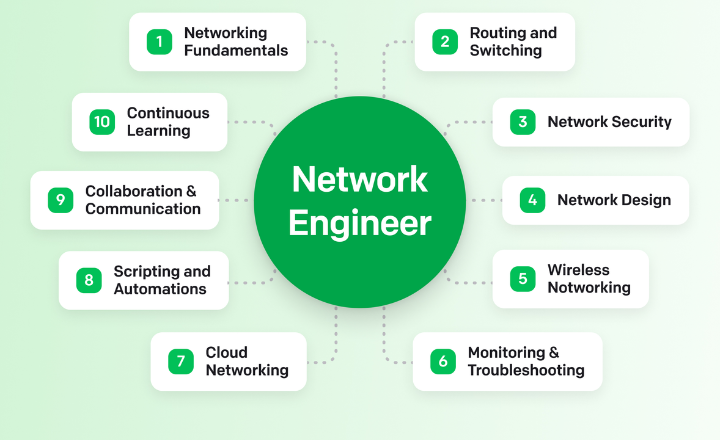
In addition, they conduct routine maintenance and upgrades to ensure that the network remains stable and capable of handling increasing data traffic. Another key responsibility is protecting sensitive information by implementing security measures that prevent cyber threats, unauthorized access, and data breaches.
Professionals in this role also communicate with different stakeholders, including colleagues, junior staff, managers, and clients, to explain how network systems function and how issues can be resolved.
Their expertise helps organizations maintain reliable connectivity, support daily operations, and adapt to the growing demands of modern digital environments.
Network Engineer vs. Network Administrator
Although the roles of a network engineer and a network administrator are closely related, they focus on different aspects of network management. A network engineer is primarily responsible for designing and developing network systems, including selecting the appropriate hardware and software needed to build a reliable infrastructure.
They plan how the network will operate, determine how devices will connect, and ensure the system can handle data traffic efficiently. Network engineers also analyze complex network issues and develop solutions to improve performance, scalability, and security.
Network Engineer – Common Problems Faced:
- Designing complex network infrastructures that can handle large amounts of data traffic.
- Ensuring network scalability so the system can grow with the organization.
- Troubleshooting major network failures or connectivity issues.
- Integrating new technologies and hardware with existing network systems.
- Protecting networks from advanced cybersecurity threats.
- Planning network architecture that is both cost-effective and high-performance.
A network administrator focuses on managing and maintaining the network after it has been implemented. Their role involves monitoring network performance, performing routine maintenance, installing updates, and ensuring that all devices remain connected and functional.
Network administrators may also add new hardware or software components, manage user access, and apply security settings to protect the system from potential threats.
In terms of qualifications, organizations often expect network engineers to have at least a bachelor’s degree in computer science, information technology, or a related field, and in some cases a master’s degree for more advanced positions.
Network administrators usually also hold a bachelor’s degree. Still, employers often place strong emphasis on professional certifications, such as networking or security certifications, which demonstrate practical skills needed to manage and maintain network systems effectively.
Network Administrator – Common Problems Faced:
- Monitoring daily network performance and resolving minor connectivity issues.
- Managing user accounts, permissions, and access control.
- Performing routine maintenance, updates, and backups.
- Fixing hardware or software problems that affect network users.
- Ensuring stable internet connectivity for employees and departments.
- Implementing security patches and protecting the network from malware or unauthorized access.
Where Do Network Engineers Work?
Network engineers work in many industries around the world because computer networks are essential for communication, data sharing, and internet access.
Today, organizations in almost every field rely on stable and secure networks to operate efficiently. Because of this, network engineers play an important role in helping businesses, institutions, and public organizations stay connected and manage their digital systems.
Most network engineers work within an organization’s IT department, where they design, monitor, and maintain network infrastructure. They often collaborate with other IT professionals, such as system administrators, cybersecurity specialists, and project managers, to ensure that the network runs smoothly.
Their work is usually performed in offices, data centers, or technology facilities where network equipment and servers are managed. In some cases, they may also travel to different company locations to install networking hardware, upgrade systems, or solve technical issues.
Network engineers are needed in many sectors, including:
- Information Technology (IT): Building and maintaining digital infrastructure for companies and online services.
- Education: Supporting network systems used for online learning, research, and campus communication.
- Government organizations: Managing secure networks used for public services and internal communication.
- Healthcare: Maintaining networks that store medical records and support hospital technologies.
- Social media and online platforms: Ensuring stable connectivity for large numbers of users.
- Military and defense organizations: Managing secure communication networks.
- Telecommunications: Developing and maintaining systems that provide internet and communication services.
What Does a Network Engineer Do?
A network engineer is responsible for ensuring that computer networks operate efficiently, securely, and without interruption. Their primary role is to design, manage, and optimize network systems that enable computers, servers, and other devices to communicate and share data.
By maintaining reliable networks, they help organizations run their digital operations smoothly and support communication between employees, clients, and online services.
Network engineers also work to protect networks from technical failures and security threats. They regularly monitor network performance, identify potential problems, and implement solutions to maintain stability and efficiency. In addition, they evaluate new technologies and recommend improvements that can enhance network speed, security, and overall performance.
Some of the key responsibilities of a network engineer include:
- Designing and installing network infrastructure, including routers, switches, and other networking equipment.
- Implementing security systems such as firewalls, antivirus protection, and data backup solutions to protect sensitive information.
- Performing routine maintenance by troubleshooting problems, updating software, and installing system upgrades.
- Providing technical support to users either remotely or on-site when network issues occur.
- Consulting with clients or departments to recommend suitable networking solutions based on their needs.
- Supervising and training junior team members to help them develop technical skills and understand network systems.
- Testing and installing new hardware, software, and applications to ensure compatibility with existing systems.
- Developing technical plans and design packages for integrating new technologies into current networks.
- Collaborating with other IT professionals, service providers, and network teams to maintain high network quality.
- Preparing reports about network performance and system status for managers or other stakeholders.
- Identifying ways to improve network efficiency and reduce operational costs through better design and management.
- Configuring network devices and software to ensure proper communication between systems.
- Monitoring network performance to detect slow connections, outages, or unusual activity.
- Managing network access and permissions to ensure that only authorized users can access sensitive data.
- Developing technical documentation and reports about network performance and system updates.
- Training junior staff and guiding team members on network management practices.
- Planning network upgrades and expansions as the organization grows.
- Optimizing network performance to increase speed and reduce downtime.
- Ensuring data backup and disaster recovery systems are in place to prevent data loss.
- Researching new networking technologies and recommending improvements to reduce operational costs and increase efficiency.
Qualifications and Skills Required for Network Engineers
Becoming a network engineer requires a combination of formal education, professional certifications, technical knowledge, and soft skills. These qualifications enable professionals to design, implement, and maintain computer networks effectively while keeping systems secure and efficient.
Educational Background
A strong educational foundation is important for a career in network engineering. Most network engineers hold a bachelor’s degree in fields such as:
- Computer Science
- Computer Systems Engineering
- Information Technology
- Network Security Management
- Other related technical disciplines
These programs teach essential concepts, including how networks operate, how to build and configure networks, and how to troubleshoot network issues. Pursuing a master’s degree in a relevant field can further enhance career prospects and earning potential. Many network engineers also engage in continuing education to stay current with industry trends, emerging technologies, and professional development courses.
Certifications and Professional Training
Professional certifications help network engineers demonstrate expertise, specialize in certain technologies, and increase their earning potential. Common certifications include:
- CompTIA Network+ – foundational networking skills
- Cisco Certified Technician (CCT) Routing & Switching
- Cisco Certified Network Associate (CCNA)
- Cisco Certified Network Professional (CCNP)
- Cisco Certified Internetwork Expert (CCIE)
- VMware Certified Professional – Network Virtualization
CompTIA Network+
This entry-level, vendor-neutral certification validates foundational networking skills for troubleshooting, configuring, and managing networks.
It covers deploying wired/wireless devices (IP addressing, protocols), network operations (documentation, monitoring, disaster recovery), cloud/virtualization concepts, and security basics. Recommended for beginners with CompTIA A+ or 9-12 months of experience; prepares for roles like junior network admin.
Cisco Certified Technician (CCT) Routing & Switching
An entry-level Cisco certification focused on practical skills for technicians supporting routing and switching infrastructure.
It emphasizes installing, configuring, and basic troubleshooting of Cisco routers/switches in LAN/WAN environments. Ideal for field support roles; requires passing a single exam on hardware basics, cabling, and initial setup without deep theory.
Cisco Certified Network Associate (CCNA)
A globally recognized associate-level certification proving skills in installing, operating, and troubleshooting medium-sized enterprise networks.
Covers network fundamentals (TCP/IP, OSI model), IP connectivity, security fundamentals, automation (Python basics), and wireless access; includes routing (OSPF, BGP), switching (VLANs, STP), and SDN concepts. Single exam; bridges junior to mid-level roles.roberthalf+1
Cisco Certified Network Professional (CCNP)
Advanced professional certification for implementing and managing complex enterprise networks.
Builds on CCNA with deeper dives into routing protocols (EIGRP, BGP), VPNs, QoS, multilayer switching, and troubleshooting; requires core exam plus one concentration (e.g., Enterprise, Security).
Targets senior engineers handling scalability, security, and multi-site deployments.
Cisco Certified Internetwork Expert (CCIE)
The most prestigious Cisco expert-level certification, validating mastery in planning, operating, and optimizing mission-critical enterprise networks.
Involves 8-hour lab exam on full-scale topologies covering routing, switching, security, automation, and wireless; requires written qualifier first. For elite architects/consultants leading global infrastructures.
VMware Certified Professional – Network Virtualization (VCP-NV)
Proves expertise in designing, deploying, and managing VMware NSX-T network virtualization solutions. Covers logical switching/routing, security (micro-segmentation, firewalls), load balancing, VPNs, and integration with vSphere/multi-cloud environments.
Requires passing exam after completing VMware training; essential for SDN/virtualized data centers.
Certifications often focus on practical skills that allow engineers to design, troubleshoot, and secure networks in professional environments.
Technical Knowledge
Network engineers must have a broad understanding of technical concepts and hardware used in networking. Some key concepts include:
- Server: Device that transmits data and resources over a network.
- Client: Device that receives data and resources over a network.
- Router: Hardware that connects multiple networks, including internet access.
- Switch: Device or software that connects devices within a network.
- IP Address: A unique identifier for devices on a network to send and receive information.
- Network Traffic: The flow of data across a network at any given time.
Network engineers also work with various types of networks, such as:
- Home Network: Connects personal devices like computers, mobile phones, and printers.
- Local Area Network (LAN): Connects devices within a small area, such as an office.
- Metropolitan Area Network (MAN): Covers medium-sized areas like campuses or cities.
- Wide Area Network (WAN): Connects networks across large geographic regions, such as countries.
- Global Area Network (GAN): Uses satellite or mobile technologies to connect devices worldwide.
Essential Skills for Network Engineers
In addition to technical knowledge, network engineers need a variety of soft skills to excel in their roles:
- Problem-Solving: Quickly identifying and resolving network issues while preventing potential problems.
- Teamwork: Collaborating with other IT staff, project managers, and network professionals to maintain efficient systems.
- Leadership: Guiding junior staff, mentoring technicians, and taking initiative in network projects.
- Communication: Explaining complex networking concepts clearly to colleagues, supervisors, or clients.
- Multitasking: Managing multiple networks or projects simultaneously without losing track of important details.
- Project Management: Planning and implementing network designs systematically to avoid errors and ensure smooth deployment.
Conclusion
Network engineers play a vital role in designing, maintaining, and securing computer networks, ensuring smooth communication and reliable data transfer. They combine technical expertise with problem-solving, leadership, and teamwork skills to keep networks efficient and secure.
With the right education, certifications, and experience, network engineers can work across various industries and contribute to the growth and stability of organizations worldwide. A career in network engineering is both challenging and rewarding for those passionate about technology and innovation.