
In the world of surveying, where millimeters can make monumental differences, the choice of measuring tool is very important. While modern technology has introduced laser measures and GPS devices, the classic measuring tape remains a staple in a surveyor’s toolkit. But not all tapes are created equal.
One key factor often lies in their choice of tools, particularly the types of tapes in surveying. This article will guide you through the various tapes used in the field, detailing their strengths and ideal applications. By understanding these tools better, you’ll be prepared to make informed decisions that can elevate your surveying accuracy. Tapes are essential tools in surveying used for measuring linear distances. They come in various materials and lengths to suit different accuracy levels and survey conditions.

Cloth or Linen Tapes
When it comes to surveying, the choice of tape material can significantly impact both accuracy and usability. Cloth tapes, often marked with bold, easily readable numbers, are ideal for measuring longer distances. Their flexibility allows for easier maneuvering around obstacles, making them a go-to for fieldwork. However, they can stretch over time, so it’s essential to regularly check their accuracy to ensure reliable readings.
They typically range from 10 to 30 meters in length and are 12 to 15 mm wide. These tapes are primarily used for measuring offsets due to their flexibility and lightweight nature. They are particularly useful in situations where a rigid tape might be impractical.

Characteristics of Cloth or Linen Tapes
Cloth or linen tapes stand out among the various types of tapes in surveying due to their unique blend of flexibility and durability. Surveyors can easily read measurements, thanks to the printed markings that resist fading over time.
- Made of closely woven linen fibers
- Varnished to resist moisture
- Length ranges from 10 to 30 meters
- Width is typically 12 to 15 mm
- Usually have a brass or metal ring at one end, included in the total length.
Advantages of Cloth or Linen Tapes
Cloth or linen tapes stand out among the various types of tapes in surveying for several compelling reasons. d wrap around obstacles, making them ideal for surveying projects in rugged landscapes. This clarity reduces the possibility of measurement errors, thus enhancing the accuracy of the surveys. With these advantages, cloth and linen tapes prove to be not just tools but invaluable partners in the surveying profession.
- Easy to handle and lightweight
- Highly flexible, making them ideal for irregular terrains
- Useful for measuring offsets
- Can be easily rolled or folded for compact storage
- Generally less expensive than metal tapes
- Versatile due to dual unit markings (metric and imperial)
- Often marked in both metric and imperial units
- Lightweight and easy to handle.
- Flexible and suitable for rough or irregular terrain.
- Good for approximate measurements like offsets.
Disadvantages of Cloth or Linen Tapes
This degradation not only shortens their lifespan but can also lead to inaccuracies in measurements over time, diminishing their reliability for precision tasks.
- Easily affected by moisture, causing shrinkage
- Prone to stretching and alteration of length over time
- May twist and tangle during use
- Not as strong as chain or steel tapes
- It can be difficult to use in strong winds
- Figures may become indistinct with continuous use
- Less durable than metal tapes, requiring more frequent replacement
- Less precise for high-accuracy measurements compared to metal tapes
- Not very accurate for precise measurements.
- It can shrink when wet and elongate when pulled, affecting measurements.
- Susceptible to damage from moisture and wear.
Metallic tapes
Metallic tapes stand out in the diverse landscape of surveying tools, offering unique advantages over their non-metal counterparts. Made of materials like stainless steel or aluminum, these tapes provide exceptional durability and resistance to environmental factors. Metallic tapes are an improvement over cloth tapes, consisting of a linen tape reinforced with brass or copper wires to prevent stretching or twisting of fibers. The wires are interwoven and not visible to the naked eye due to varnishing.
Characteristics of Metallic Tapes
Metallic tapes are a versatile choice in the toolbox of surveying professionals, primarily due to their durability and resistance to environmental factors. Their reflective surfaces also provide increased visibility, helping surveyors read measurements accurately in bright sunlight or low-light conditions.
- Composed of linen reinforced with brass or copper wires
- Varnished surface concealing the interwoven wires
- Available in various lengths, with 20m and 30m being most common
- Usually supplied in leather cases with a winding device
- Divided into decimeters and centimeters for precise measurements
- Typically wider than cloth tapes, providing better handling
Advantages of Metallic Tapes
Metallic tapes offer a unique blend of durability and precision that makes them an invaluable tool in surveying. Unlike traditional cloth or plastic tapes, metallic options provide a level of resistance to extreme weather conditions, ensuring accuracy even in the harshest environments.
- More durable than cloth tapes due to metal reinforcement
- Resistant to stretching and twisting, maintaining accuracy over time
- More accurate than cloth tapes for measurements
- Suitable for a wider range of surveying tasks
- Commonly used for offset measurements in chain surveying
- The leather case and winding device offer better protection and storage
- Easier to read due to clear markings and reduced wear
- More durable than cloth tapes.
- Suitable for topographical surveys where minor errors are acceptable.
Disadvantages of Metallic Tapes
While metallic tapes are prized for their durability and precision, they come with notable disadvantages that can hinder their effectiveness in various surveying applications.
- Heavier than cloth tapes, which may affect portability
- More expensive than cloth tapes
- Can be affected by temperature changes, though less than steel tapes
- May still be prone to some stretching over extended use
- Not as accurate as steel or invar tapes for high-precision measurements
- Can be damaged if bent sharply or kinked
- Requires more careful handling and storage than cloth tapes
- Still less precise than steel or invar tapes.
- Can be heavier than cloth tapes.
Steel Tapes
Steel tapes are indispensable tools in surveying, offering precision and durability that other measuring devices often can’t match. Steel tapes offer a higher degree of accuracy compared to cloth and metallic tapes. They consist of a light strip of steel with precise graduations, providing reliable measurements for various surveying tasks.

Characteristics of Steel Tapes
When diving into the characteristics of steel tapes, it’s essential to recognize their unique advantages in surveying applications. Steel tapes are renowned for their durability and resistance to wear, ensuring accuracy and longevity even in the most challenging environmental conditions.
- Made of a thin strip of steel, typically 6 to 10 mm wide
- Available in various lengths (10m, 20m, 30m, and 50m are common)
- Equipped with a brass ring at the end, included in the total length
- Wound in a leather or metal case with a winding device
- Feature precise graduations for accurate measurements
- Often includes both metric and imperial units
Advantages of Steel Tapes
When it comes to the types of tapes in surveying, steel tape measures stand out for their exceptional durability and precision. This reliability is particularly crucial in large-scale projects, where even minor discrepancies can lead to significant errors.
- Provide more accurate measurements than cloth or metallic tapes
- Highly durable and resistant to stretching
- Less affected by temperature changes compared to cloth or metallic tapes
- Maintain accuracy over long periods of use
- Suitable for a wide range of surveying applications
- Can be used for precise distance measurements in most conditions
- Clearly visible graduations for easy reading
- More accurate and durable than cloth or metallic tapes.
- Resistant to elongation under tension.
- Suitable for standardizing chains and construction measurements.
Disadvantages of Steel Tapes
While steel tapes are a staple in surveying due to their durability and precision, they come with notable disadvantages that can impact fieldwork. One significant drawback is their weight; these tapes can be cumbersome, especially during long surveys where portability plays a crucial role. Steel tapes can expand or contract based on temperature changes, leading to measurement inaccuracies if proper precautions aren’t taken.
- Not suitable for use in areas with dense vegetation or rocky terrain due to their delicate nature
- Can be damaged if bent sharply or kinked
- Heavier than cloth or metallic tapes, which may affect portability
- More expensive than cloth or metallic tapes
- Can be affected by temperature changes, requiring corrections for high-precision work
- May rust if not properly maintained and stored
- It can be dangerous if snapped under tension
- Requires careful handling to prevent damage to the tape or injury to the user
- Not flexible; best suited for leveled surfaces.
- Prone to corrosion if not properly maintained (must be cleaned and oiled).
- Heavier to carry and handle.
Steel tapes are widely used in professional surveying due to their high accuracy and durability. They are ideal for precise distance measurements in most surveying applications, particularly in construction, engineering, and land surveying. However, their use requires more care and skill compared to cloth or metallic tapes, especially in challenging terrains or extreme weather conditions.
Invar Tapes
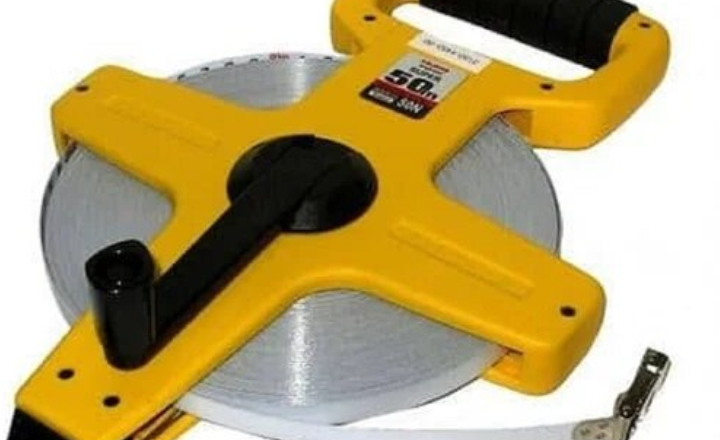
In the realm of surveying, Invar tapes stand out for their exceptional precision and stability under varying temperatures. Invar tapes are specialized measuring devices made from an alloy of nickel (36%) and steel (64%). They are named after the material “invar,” which is known for its extremely low coefficient of thermal expansion.
Characteristics of Invar Tapes
Invar tapes are distinctive in the realm of surveying due to their exceptional thermal stability and minimal thermal expansion.
- Made of invar alloy (36% nickel, 64% steel)
- Extremely low coefficient of thermal expansion (0.000000122 per 1°C)
- Available in lengths of 30m, 50m, and 100m
- Typically 6 mm wide
- Designed for high-precision measurements
- Often feature specialized graduation markings
Advantages of Invar Tapes
Invar tapes offer a unique advantage in surveying due to their incredible dimensional stability. This precision is particularly critical when conducting long-distance measurements, as even the slightest error can lead to significant inaccuracies.
- Provide more accurate measurements than cloth or metallic tapes
- Highly durable and resistant to stretching
- Less affected by temperature changes compared to cloth or metallic tapes
- Maintain accuracy over long periods of use
- Suitable for a wide range of surveying applications
- Can be used for precise distance measurements in most conditions
- Clearly visible graduations for easy reading
- Highly precise; ideal for baseline measurements and triangulation.
- Minimal elongation or shrinkage with temperature variations.
Disadvantages of Invar Tapes
Invar tapes require careful storage and usage to prevent damage, as they can be delicate compared to other types of tapes in surveying, like steel or fiberglass.
- Significantly more expensive than other types of tapes
- Softer and more easily deformed than steel tapes
- Develops creep over time, potentially affecting long-term accuracy
- The coefficient of thermal expansion may change over extended periods
- Require multiple assistants to handle and stretch properly
- Need very careful handling to avoid bending and kinking
- Not suitable for ordinary surveying work due to cost and handling requirements
- More challenging to repair or replace due to specialized material
- Require specialized storage and maintenance procedures
- Limited availability compared to other tape types
- More expensive than other tapes.
- Must be handled carefully to avoid kinks or bends.
Invar tapes are highly specialized tools designed for the most demanding precision measurements in surveying and scientific applications. While they offer unparalleled accuracy in certain conditions, their use is generally limited to specific high-precision tasks due to their cost, handling requirements, and potential for deformation. They are typically used in establishing precise baselines for large-scale surveys, scientific research, and other applications where even minute measurement errors can have significant impacts.
conclusions
Choosing the right kind of tape for surveying can have a big impact on the calibre of your data collection and the final results of your project. Each tape has unique advantages that can be tailored to different surveying settings, ranging from the suppleness of fabric tapes to the lightweight convenience of fiberglass and the durability of steel tapes. By being aware of these kinds, surveyors can make well-informed decisions that guarantee precise and trustworthy measures. Professionals will need to stay up to date with tape technology developments as the field continues to evolve.