
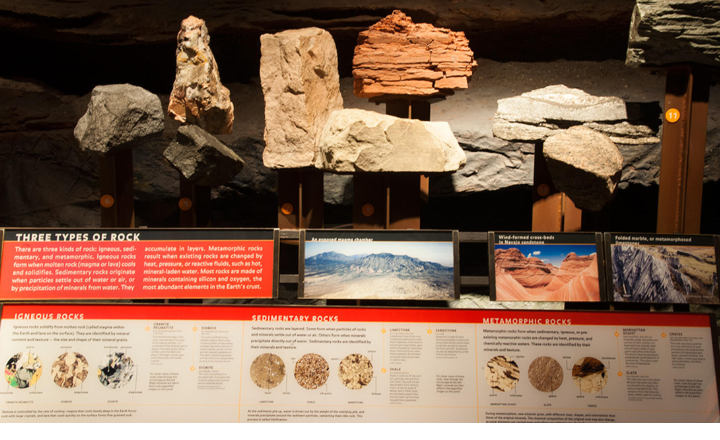
Rocks’ crystalline structure, texture, and chemical and mineralogical makeup are all significantly influenced by their formation and origin. These qualities play a crucial role in the engineering and financial evaluation of rocks for use in a variety of infrastructure and architectural projects since they not only define the rocks’ strength but also their aesthetic attractiveness.
Imagine strolling along a beach with many stones all around you, each one telling a tale. For geologists and environmental lovers alike, the classification of rocks is crucial because it offers insights into the workings of the planet.
Classification of Rocks
- Geological
- Physical
- Chemical
Geological Classification
This refers to how rocks are classified based on their origin and formation processes, primarily into igneous, sedimentary, and metamorphic types, as explained earlier. It involves understanding mineral composition, texture, and formation history, which helps in identifying and categorizing rocks on a broad scientific basis.
Physical Properties
Physical properties are measurable characteristics of rocks that relate to their external or internal features. These include:
- Color: Influenced by mineral content.
- Texture: Grain size, shape, and arrangement.
- Hardness: Resistance to scratching, measured by the Mohs scale.
- Density and Specific Gravity: Mass per unit volume.
- Porosity and Permeability: How much fluid a rock can hold and pass through.
- Reaction with acids: Certain rocks, like limestone, react with acids due to carbonate minerals.
These properties are essential in practical applications such as construction, resource extraction, and engineering.
Chemical Properties
Chemical properties describe the composition and chemical reactions of rocks. These include:
- Mineral content and chemical composition: Such as silica, calcite, and iron oxides.
- Chemical reactions: For example, limestone reacts with acids to produce carbon dioxide gas.
- Precipitation and Organic Content: As seen in chemical sedimentary rocks like travertine or organic carbonates.
These properties determine how rocks interact with environmental factors and are crucial in processes like mineral exploration and understanding rock stability.
Based on the Geological Formation
Igneous Rocks
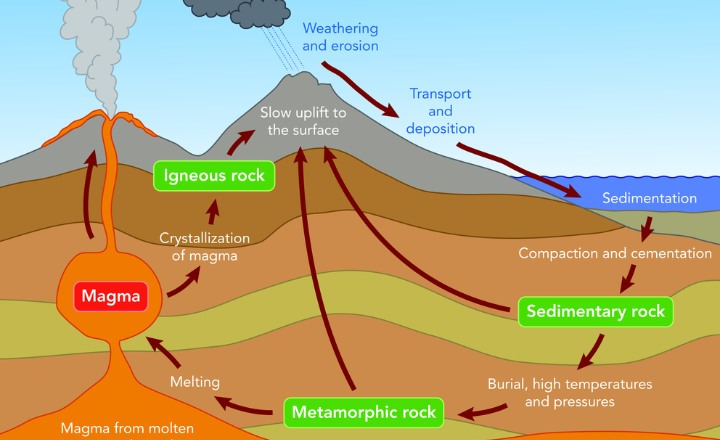
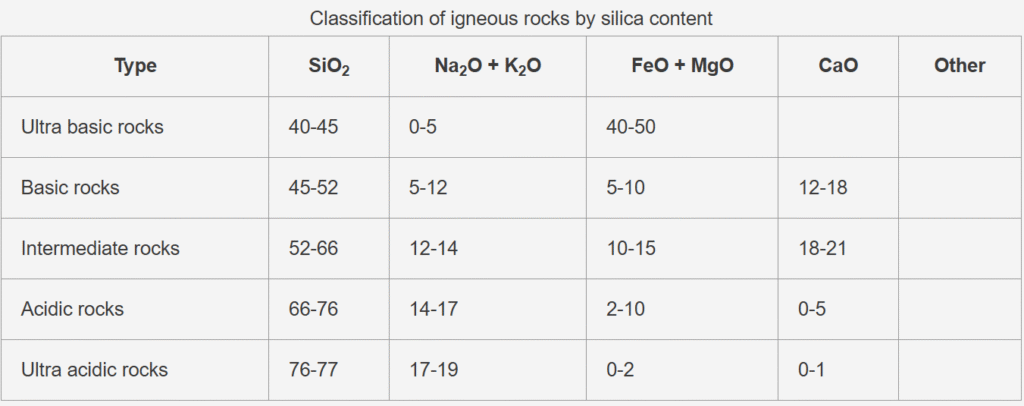
Igneous rocks, sometimes referred to as primary, unstratified, or eruptive rocks, are formed by volcanic eruptions and are created when molten masses that are either above or below the Earth’s surface solidify. Silicate masses melt as a result of the Earth’s core layers’ high temperatures.
Through volcanic eruptions, this molten mass—known as magma—is driven upward and dispersed throughout the Earth’s surface, where it hardens to form effusive rocks, such include trap and basalt.
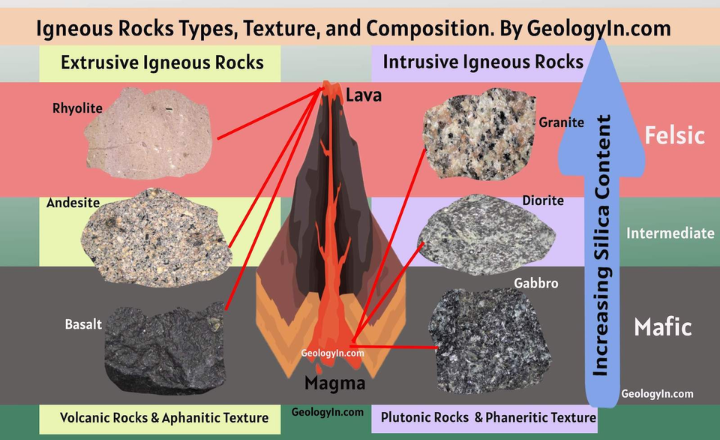
Molten rock, either magma (found beneath the Earth’s surface) or lava (found when it erupts onto the surface), cools and solidifies to produce igneous rocks. Magma is created when existing rocks are melted by intense heat deep within the Earth.
Sedimentary Rocks
Rain, sun, air, and frost are some of the weathering elements that break down the Earth’s surface to create sedimentary rocks, sometimes referred to as watery or stratified rocks. Rainwater takes the bits of the surface that are broken up by these processes to the rivers. These rivers’ velocity drops as they move downhill, allowing sediments—such as broken rock fragments, sand, silt, clay, trash, etc.—to settle in the stream. Seasonal fluctuations cause this settling to occur in layers. The pressure from the overlaying material causes the sediments to gradually solidify into horizontal beds.
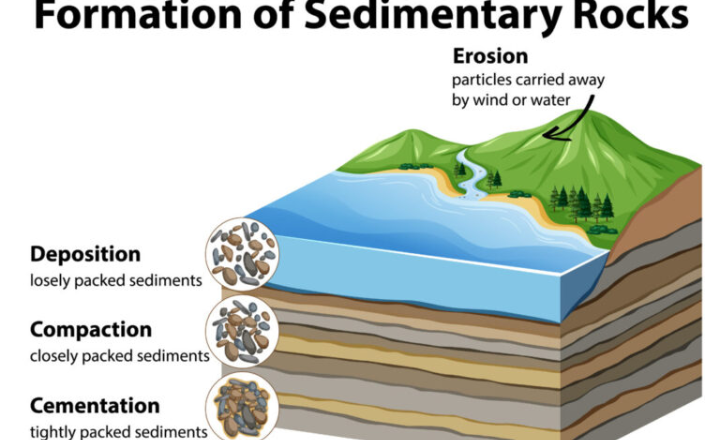
Sedimentary rocks often display layering or stratification, with the oldest layers at the bottom. They are characterized by varied grain size and composition, and may include fragments of fossils. Common types include sandstone, limestone, shale, and chalk. These rocks cover about 75% of the Earth’s surface and are significant in natural resource formation and for building materials.
Metamorphic Rocks
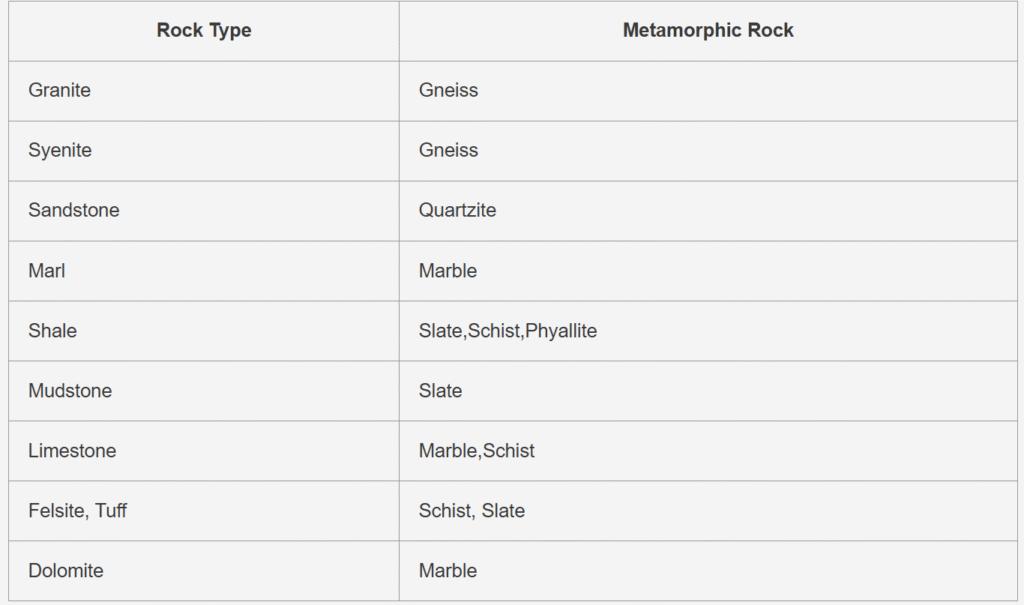
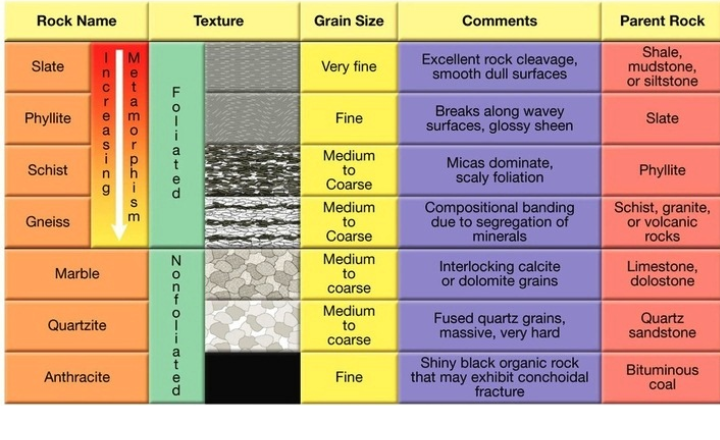
Metamorphic rocks form when preexisting rocks (igneous, sedimentary, or other metamorphic rocks) are transformed by heat, pressure, and chemically active fluids beneath the Earth’s surface, without the rock melting. This process, called metamorphism, causes changes in mineral composition and texture while the rock remains solid. The original rock, known as the protolith or parent rock, experiences recrystallization, chemical reactions, and structural reorientation under increased temperature (typically between 200°C and 1100°C) and pressure conditions.
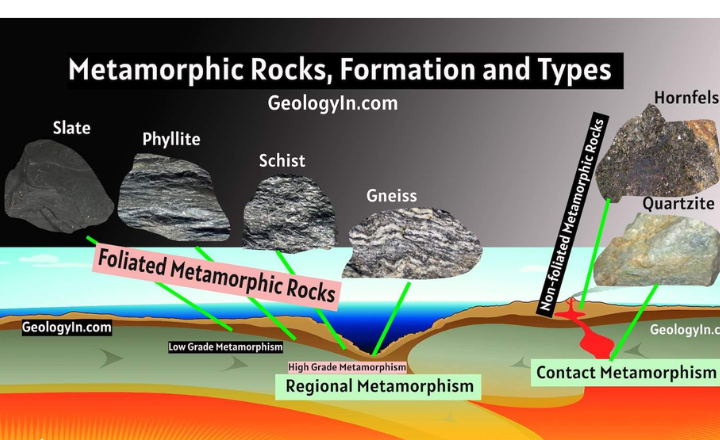
The formation of metamorphic rocks occurs when either igneous or sedimentary rocks undergo transformation due to the effects of earth movements, changes in temperature, liquid pressures, and other geological processes. This transformation leads to the creation of rocks with distinct characteristics. Metamorphic rocks may exhibit a foliated structure, as seen in slate, gneiss, schist, and phyllite, or a non-foliated structure, as seen in marble, quartzite, and serpentine.
Based on Physical Properties
- Stratified rocks exhibit discrete strata that allow for rock splitting. Examples include marble, slate, sandstone, limestone, shale, and so forth.
- Unstratified rocks are difficult to divide into thin strata and do not exhibit any stratification. These rocks include traps, granite, and basalt, among others.
- Foliated Rocks are common for foliated rocks to only split in one direction. With the exception of marble and quartzite, which contain granulose structures, the majority of metamorphic rocks have foliated structures.
Based on Chemical Properties
The rock might be categorized as calcarious, silicious, or argillaceous.
- Argillaceous: Clay (Al2O3) is the main component. Slate, laterite, and other hard, brittle rocks are among them.
- Silicious: Silica (SiO2), or sand, is the main component. The rocks—granite, basalt, trap, quartzite, gneiss, syenite, etc.—are extremely resistant and hard.
- Calcarious: Lime, such as limestone, marble, dolomite, etc., is the main component.
Conclusions
In conclusion, understanding Earth’s geology and the numerous processes that influence it requires an understanding of the rock classification system. Important hints regarding the Earth’s history and the development of its landscapes can be gleaned by differentiating between igneous, sedimentary, and metamorphic rocks. This information helps with a variety of applications, such as resource exploration and environmental preservation, in addition to enhancing our understanding of the globe. We must acknowledge our obligation to preserve and safeguard these geological gems as we continue to research these classifications. Allow this information to motivate you to learn more about the natural structures of the Earth and their importance to our existence.