
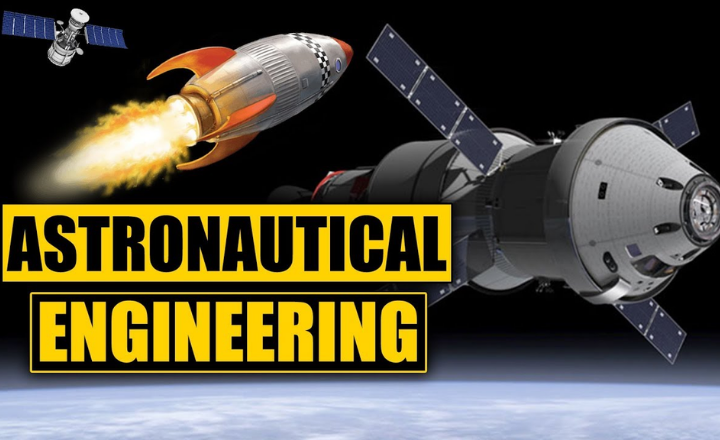
Astronautical engineering is a specialized branch of aerospace engineering focused on the design and operation of vehicles that function beyond Earth’s atmosphere.
Astronautical engineering is a subset of aerospace engineering that focuses on developing advanced technologies for aviation, space and airborne defense systems. The systems and devices astronautical engineers create and maintain help with broadcasting, communication, navigation and remote sensing. This field of engineering is also known as rocket science.

Astronautical engineers use principles of physics, mathematics, and systems engineering to design launch vehicles, calculate orbital trajectories, manage spacecraft re-entry, and support long-duration space missions. The field combines multiple disciplines, including propulsion, thermal control, astrodynamics, and space systems engineering, making it one of the most complex and mission-driven areas of aerospace engineering.
What Astronautical Engineering Covers
Spacecraft and Satellite Design
Astronautical engineers design satellites, space stations, and deep-space probes by integrating structural systems, power generation, thermal control, and communication technologies. These systems must survive intense launch forces and operate reliably in the harsh environment of space over long periods.
Orbital Mechanics and Astrodynamics
A core area of astronautical engineering is the calculation of orbital paths and maneuvers. Engineers plan satellite orbits, transfer trajectories, rendezvous operations, and station-keeping strategies to ensure mission accuracy and fuel efficiency.
Launch Vehicles and Rocket Systems
The design of rockets and launch vehicles is a key responsibility in this field. Engineers work on propulsion systems, fuel storage, guidance and control, and multi-stage separation to safely deliver payloads into orbit or beyond Earth.
Re-entry Physics and Thermal Protection
When spacecraft return to Earth or enter another planet’s atmosphere, they experience extreme heat and pressure. Astronautical engineers design thermal protection systems and heat shields that allow spacecraft to safely withstand re-entry and landing conditions.
Space Environment and Mission Conditions
Spacecraft must operate in vacuum, radiation-rich environments, and wide temperature ranges. Engineers analyze these conditions and develop protective systems to ensure the reliability of onboard electronics, structures, and human life-support systems.
Long-Duration and Deep-Space Missions
For missions to the Moon, Mars, and deep space, astronautical engineers focus on trajectory planning, power management, communication delays, system autonomy, and long-term reliability. These missions require careful balance between fuel efficiency, safety, and mission objectives.
Role of Astronautical Engineers in 2026
Astronautical engineers are the technical experts behind spacecraft, satellites, rockets, and advanced space systems that operate within and beyond Earth’s atmosphere.
By 2026, their role has become even more critical as government space agencies and private companies expand satellite constellations, develop lunar exploration programs, and plan deep space missions. These engineers apply advanced physics, mathematics, and engineering principles to design, develop, test, and upgrade space vehicles and their subsystems.
Many astronautical engineers specialize in focused technical areas such as spacecraft design, structural engineering, astrodynamics, propulsion systems, software development, electrical systems, or electronics.
This specialization allows complex space missions to be divided into manageable subsystems while maintaining overall mission reliability and performance.
Core Responsibilities of Astronautical Engineers
Astronautical engineers work closely with multidisciplinary teams that may include aerospace engineers, physicists, software developers, and mission planners. Their primary responsibility is to translate mission requirements into functional spacecraft systems. This involves defining system architectures, performing feasibility studies, running simulations, and assessing risks to ensure that designs meet safety, reliability, and performance objectives.
They often play a key role in systems engineering, ensuring that all spacecraft subsystems such as propulsion, structures, avionics, thermal control, and power are properly integrated and operate together as a single, efficient system.
Spacecraft Design, Development, and Testing
Design and development form a major part of an astronautical engineer’s work. Engineers design spacecraft components ranging from satellite platforms and rocket stages to docking mechanisms and scientific instruments. Using tools such as computer-aided design (CAD), finite-element analysis, and orbital-mechanics software, they model how spacecraft will perform during launch, in orbit, and during re-entry or planetary landing.
Testing is equally important. Astronautical engineers support prototype manufacturing, conduct structural, thermal, and vibration tests, and analyze test data to refine designs.
In 2026, this work increasingly involves reusable launch vehicles, small satellites, and autonomous spacecraft that must operate reliably for years with limited human intervention.
Mission Planning and Space-Environment Engineering
Beyond hardware design, astronautical engineers handle mission-level planning tasks such as trajectory analysis, orbit selection, and maneuver planning. They calculate launch windows, transfer orbits, and station-keeping strategies for Earth-orbiting satellites, lunar missions, and interplanetary probes.
These calculations account for complex factors such as gravitational influences, atmospheric drag, and solar radiation pressure.
Engineers must also design systems capable of surviving harsh space environments. This includes protecting spacecraft from extreme temperature variations, radiation exposure, vacuum conditions, and micrometeoroid impacts. Advanced materials, thermal-control systems, and radiation-hardened electronics are commonly used to ensure long-term mission success.
Quality Assurance, Documentation, and Operations Support
Astronautical engineers contribute significantly to quality assurance processes by defining inspection methods, acceptance criteria, and testing standards for spacecraft components. They evaluate designs against regulatory and customer requirements, investigate hardware failures, and recommend corrective actions to improve reliability and safety.
Detailed documentation is another critical responsibility. Engineers maintain design specifications, test reports, and operational manuals that support manufacturing, integration, launch, and on-orbit operations.
In 2026, many astronautical engineers also support mission control teams by monitoring spacecraft health, diagnosing anomalies, and planning software updates or operational adjustments for long-duration missions.
Work Environments and Career Pathways
Most astronautical engineers work for government space agencies, defense organizations, research institutions, or companies contracted to build spacecraft and launch systems.
The rapid growth of commercial space has also created opportunities in private companies focused on satellite constellations, space-based communications, Earth observation, and lunar logistics.
Although astronautical engineers are not astronauts by definition, many professionals in human spaceflight programs come from this background. Some engineers move into roles supporting crewed missions directly, while a select few transition into astronaut training and spaceflight roles themselves.
Difference Between Astronautical, Aerospace, and Aeronautical Engineering
Astronautical engineering focuses exclusively on space based vehicles and missions, while aeronautical engineering deals with aircraft operating within Earth’s atmosphere.
Aerospace engineering encompasses both fields, but astronautical engineering places greater emphasis on orbital mechanics, space environments, and full mission integration. Collaboration with space science and planetary research further distinguishes this field from traditional aeronautical engineering.
Astronautical engineering is best understood as a specialized area within the broader field of aerospace engineering, rather than a completely separate discipline.
Aerospace engineering acts as an umbrella term that covers all vehicles that fly, whether inside or outside Earth’s atmosphere, while astronautical engineering zooms in specifically on spacecraft, satellites, rockets, and other systems designed to operate in space.
This means that aerospace engineering includes both aeronautical engineering (focused on aircraft within the atmosphere) and astronautical engineering (focused on vehicles beyond it), with astronautical being the more niche, space‑oriented branch.
- The main difference lies in the environment and mission type each branch deals with. Astronautical engineers work with the science and technology of designing spacecraft and satellites, including orbital mechanics, launch systems, re entry physics, and long duration space missions.
They deal with vacuum, microgravity, intense radiation, and extreme thermal conditions, and they plan trajectories for orbits around Earth or interplanetary travel. In contrast, aerospace engineers who specialize in aeronautics focus on aircraft such as commercial jets, military fighters, helicopters, and drones that operate within Earth’s atmosphere, emphasizing aerodynamics, airbreathing propulsion, and atmospheric flight performance. - Despite this distinction, there is significant overlap between the two. Both astronautical and aeronautical engineers rely on similar core skills fluid dynamics, structural analysis, materials science, thermodynamics, and control theory as well as shared tools such as computational modeling, simulation software, and systems‑engineering methods.
Many aerospace companies and space agencies employ engineers whose training spans both domains, especially when designing vehicles that must transition between atmospheric and space flight, such as spaceplanes or reusable launch systems. - It is also worth noting that astronautical engineers are not astronauts by title, since astronauts are crew members who fly in space rather than engineers who design the vehicles. However, many astronauts have backgrounds in astronautical or aerospace engineering, because the deep technical understanding of spacecraft systems, orbital motion, and mission design is highly valuable for operating in space.
In this sense, astronautical engineering provides the foundational knowledge that can lead not only to designing spacecraft but also to eventually flying on them.
Career Roles and Applications
Astronautical engineers work on communication and navigation satellites, Earth-observation systems, launch vehicles, and space exploration missions.
They are involved in the development of space capsules, re-entry vehicles, planetary landers, and deep-space probes. Opportunities exist in government space agencies, defense organizations, research institutions, and private space companies.
Conclusion
Astronautical engineering is the discipline that enables humanity’s expansion beyond Earth. By combining advanced engineering, precise calculations, and systems-level thinking, it makes satellites, rockets, and deep-space missions possible, turning space exploration from concept into reality
In 2026, astronautical engineers are at the center of global space exploration and commercialization. From designing advanced spacecraft to planning complex missions and supporting long-term operations, their work enables satellites, rockets, and deep-space missions to function safely and effectively. As space activity continues to grow, astronautical engineering remains one of the most dynamic and impactful fields in modern engineering