
Advanced Driver Assistance Systems (ADAS) are a collection of technologies designed to enhance the safety and operation of vehicles by assisting drivers in various driving tasks. These systems use sensors, cameras, radar, and other automated technologies to detect obstacles, monitor driver behavior, and respond appropriately to prevent accidents and improve road safety.
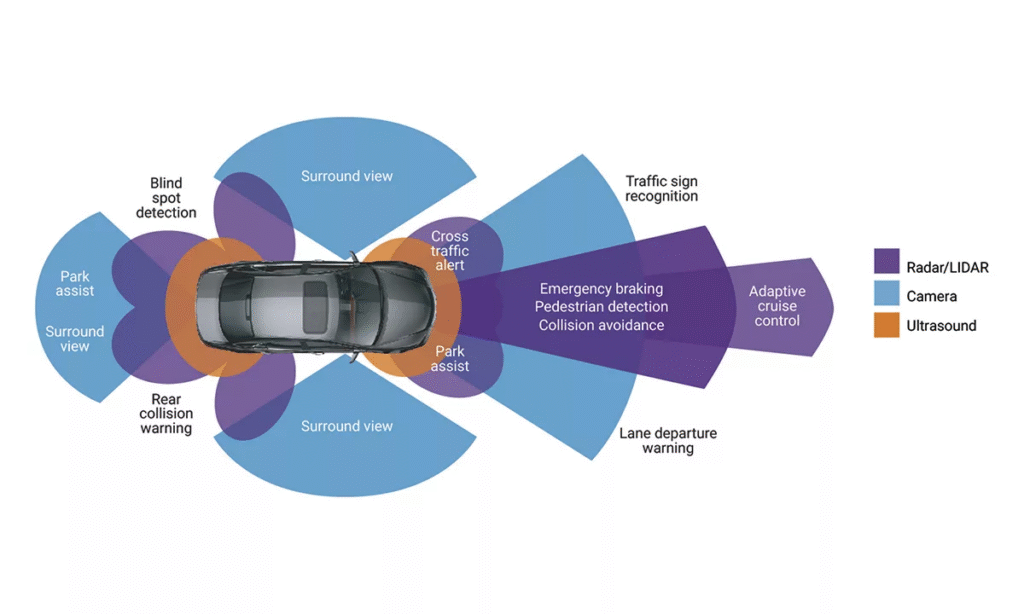
Essential safety-critical ADAS applications include:
- Pedestrian detection/avoidance
- Lane departure warning/correction
- Traffic sign recognition
- Automatic emergency braking
- Blind spot detection
These lifesaving systems are key to the success of ADAS applications. They incorporate the latest interface standards and run multiple vision-based algorithms to support real-time multimedia, vision coprocessing, and sensor fusion subsystems.

The moderinization of ADAS applications is the first steps toward realizing autonomous vehicles.
How Does ADAS Work?
Automobiles are the foundation of the next generation of mobile-connected devices, with rapid advances being made in autonomous vehicles. Autonomous application solutions are partitioned into various chips, called systems on a chip (SoCs). These chips connect sensors to actuators through interfaces and high-performance electronic controller units (ECUs).
Self-driving cars use a variety of these applications and technologies to gain 360-degree vision, both near (in the vehicle’s immediate vicinity) and far. That means hardware designs are using more advanced process nodes to meet ever-higher performance targets while simultaneously reducing demands on power and footprint.
What Are Some ADAS Applications?
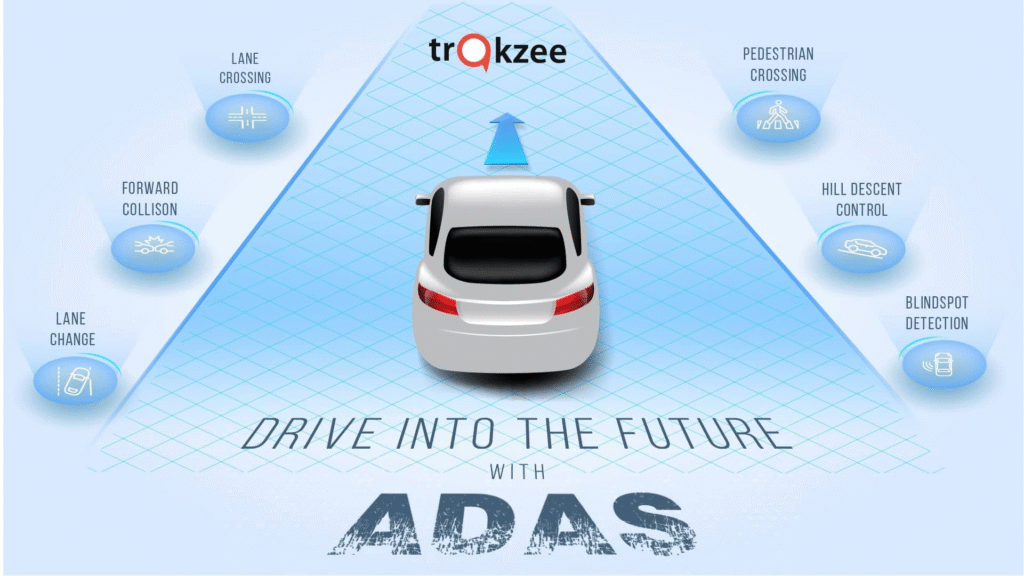
Advanced Driver Assistance Systems (ADAS) encompass various applications designed to enhance vehicle and driver safety by assisting with driving tasks and improving situational awareness. Some common ADAS applications include:
- Adaptive Cruise Control (ACC): Automatically adjusts the vehicle’s speed to maintain a safe distance from the vehicle ahead, useful especially on highways. It can accelerate, decelerate, and sometimes bring the car to a stop based on surrounding traffic conditions.
- Automatic Parking: Assists or takes control to park the vehicle by using sensors and cameras to detect obstacles and guide steering.
- Crosswind Stabilization: Helps maintain vehicle stability by applying brakes to wheels affected by strong crosswinds.
- Driver Drowsiness Detection: Monitors signs of driver fatigue or distraction through sensors analyzing head movement, heart rate, or driving behavior, and issues alerts.
- Electronic Stability Control (ESC): Detects and reduces loss of traction to prevent skidding by adjusting brake pressure.
- Autonomous Emergency Braking (AEB): Automatically applies brakes to avoid or mitigate collisions.
- Lane Departure Warning and Lane Keeping Assistance: Alerts the driver if the vehicle departs from its lane without signaling, and may assist in steering to keep the vehicle in lane.
- Blind Spot Detection: Alerts the driver of vehicles or obstacles in blind spots.
- Traffic Sign Recognition: Detects and displays road signs like speed limits to assist driver awareness.
- Adaptive Lighting: Adjusts headlights strength and direction based on external lighting conditions and traffic to improve night driving visibility without dazzling other drivers.
- Pedestrian Sensing: Detects pedestrians to help avoid collisions.
These applications collectively aim to reduce accidents, enhance driving comfort, and improve overall road safety
System Architecture / Block Diagram
Advanced Driver Assistance Systems (ADAS) architecture typically includes several key functional modules structured in a block diagram format. The main architectural components are:
- Sensor input modules: These include cameras, LiDAR, radar, and ultrasonic sensors that collect raw data from the vehicle’s surroundings.
- Perception module: Processes raw sensor data to detect and classify objects like vehicles, pedestrians, traffic signs, lane markings, and obstacles.
- Localization and mapping module: Uses sensor data to locate the vehicle in a 3D map and track object positions around it.
- Prediction module: Predicts the future movements of objects and the ego vehicle by projecting their kinematics (position, velocity, acceleration).
- Path planning module: Plans optimal vehicle routes based on perception, localization, and prediction data to ensure safe and comfortable navigation.
- Control and execution module: Converts planned paths into control commands for acceleration, braking, and steering to execute the driving plan.
Advanced Driver Assistance Systems (ADAS) require both sophisticated hardware and software components to function effectively, with stringent requirements for real-time processing, reliability, safety, and integration:
Hardware Requirements
- Processing Platforms: ADAS demands high-performance processors with architectural flexibility, scalability, and the ability to handle parallel processing. FPGA (Field Programmable Gate Array) and multicore processors are commonly used to meet the complex real-time processing needs from multiple sensor inputs like cameras, radars, and lidars. These platforms must efficiently manage video streams and sensor fusion while maintaining low latency and high throughput.
- Memory: High-speed, low-latency DRAM is essential to process the enormous amount of sensor data quickly, paired with NAND flash for long-term data storage. Embedded memory components must be reliable under harsh automotive conditions.
- Automotive-Grade Components: Hardware must meet automotive standards such as AEC-Q101, ensuring robust reverse polarity protection, thermal stability, and overall durability with minimal power loss.
- Sensors: Various sensors including cameras, radar, ultrasonic sensors, and lidar are needed for comprehensive environmental perception.
- Electronic Control Units (ECUs): Multiple ECUs or centralized high-performance computing units control different ADAS functions like adaptive cruise control, emergency braking, and lane-keeping.
Software Requirements
- Real-Time Processing and Sensor Fusion: Algorithms must process multi-sensor data streams in real time for situational awareness, object detection, collision avoidance, and driver assistance.
- Algorithm Complexity: Includes AI/Neural networks for vision processing, sensor fusion, path planning, and decision making.
- Simulation and Verification: Software design requires extensive simulation environments for scenario testing before deployment, including tools like MATLAB & Simulink for data analysis, algorithm design, testing, and integration.
- Safety and Security: Software must ensure functional safety compliance, secure communication, and robustness against faults.
- Deployment: Software development involves auto-code generation for embedded platforms and integration into service-oriented architectures (e.g., ROS, AUTOSAR).
Integration and Design Principles
- ADAS hardware and software systems must coordinate closely for real-time performance while adhering to automotive quality, safety, and security standards.
- Efficiency in power consumption and thermal management is crucial due to limited vehicle space and environmental constraints.
- Constant validation through in-vehicle testing, simulation, and other verification methods ensures that all components function seamlessly in diverse driving conditions.
This combination of high-performance hardware components (FPGAs, multicore CPUs, high-speed memory, sensors) and advanced software algorithms (sensor fusion, AI, control software) forms the foundation of effective ADAS technology. The system must be designed for reliability, scalability, and compliance with automotive industry standards for safe operation.
System Design and Implementation
- Sensor Integration: ADAS design involves integrating multiple sensors such as cameras, radar, lidar, ultrasonic, GPS, and infrared to collect comprehensive data for real-time environment perception and decision-making.
- Functional and Safety Requirements: The system design starts with defining precise functional requirements, including desired features, operational constraints, safety, and fault-tolerance with emphasis on minimizing false alarms and missed detections.
- Modular Architecture: ADAS employs a modular design approach with distinct modules for environment sensing, control algorithms, actuators, and driver interface, facilitating easier system integration and verification.
- Control and Execution: The core control system processes sensor data to generate commands for vehicle movement (e.g., steering, braking, acceleration), aiming for safe and comfortable driving behavior.
- Real-time Performance and Reliability: The system must process complex sensor inputs and make timely decisions under varying conditions (lighting, weather) with high reliability to avoid accidents and enhance driver safety.
Algorithm / Flowchart Explanation
Advanced Driver Assistance Systems (ADAS) algorithms consist of multiple stages integrated to enhance vehicle safety and driving performance through sensor data processing, decision making, and control actions. The typical ADAS algorithm flowchart includes these key components:
- Sensor Data Acquisition: Collect raw data from cameras, radar, LiDAR, and other sensors.
- Preprocessing: Clean and prepare data for analysis, including image enhancement or noise filtering.
- Feature Extraction: Detect relevant features such as lanes, vehicles, pedestrians, obstacles using computer vision techniques (e.g., edge detection, object classification).
- Object Detection and Tracking: Apply algorithms to identify and track moving and stationary objects in the vehicle’s environment.
- Situation Analysis: Interpret sensor data to understand traffic scenarios, lane position, potential collision risks, etc.
- Decision Making: Use heuristics or machine learning to decide on actions like braking, steering, or alerting the driver.
- Control Execution: Translate decisions into commands for vehicle actuators (steering, throttle, brakes).
Simulation or Prototype Model
Advanced Driver Assistance Systems (ADAS) simulation or prototype models are virtual or physical setups used to design, test, and validate ADAS technologies before full-scale production.
Simulation uses software to explore design options, validate system behavior, and predict complex interactions of various technologies under millions of virtual driving scenarios, including rare and hazardous conditions that would be difficult or unsafe to replicate in real-world testing.
This virtual testing accelerates development, ensures regulatory compliance, and builds consumer trust by enabling extensive evaluation without the costs and risks associated with on-road testing.
Prototype models can be physical vehicles equipped with ADAS components subjected to hardware-in-the-loop (HIL) testing or rapid proof-of-concept trials.
These prototypes combine sensor, controller, actuator, and vehicle dynamics in a controlled environment to verify real-time system performance and integration. Such testing stages typically follow initial simulations and help refine controller algorithms and system reliability under near-real driving conditions.
In essence, simulation models provide a highly flexible, scalable environment for early-stage innovation and safety assurance, while prototype models offer practical validation and adjustments before mass deployment in vehicles.
Results and Analysis
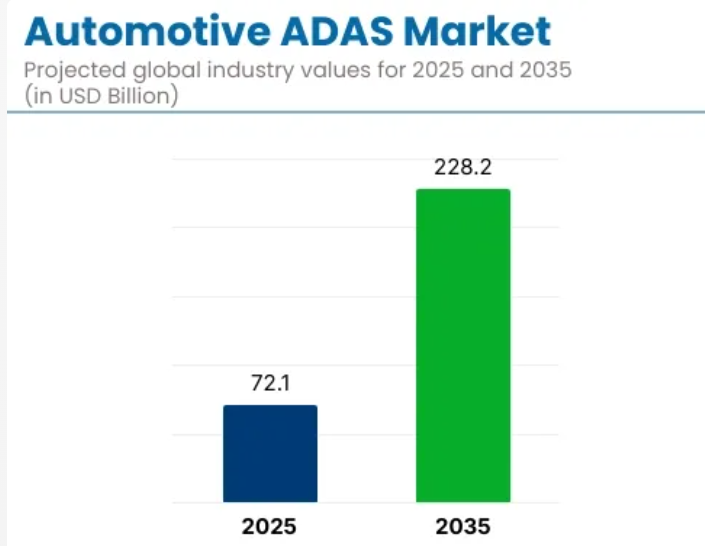
Advanced Driver Assistance Systems (ADAS) are showing significant positive results in enhancing vehicle safety and driving comfort. In 2025, the global ADAS market is valued at USD 72.1 billion and is expected to grow robustly to USD 228.2 billion by 2035, driven by regulatory safety mandates, sensor technology advancements, and consumer demand.
Studies have shown that ADAS features like automatic emergency braking (AEB) can reduce front-to-rear crashes by 49%, and technologies such as forward collision warning, blind spot detection, and lane-keeping assistance effectively prevent accidents and improve driver safety.futuremarketinsights+2
Meta-analyses confirm statistically significant reductions in crash rates due to ADAS, and projections estimate that widespread adoption of these systems could avoid hundreds of thousands of fatalities and millions of injuries by 2050.
Drivers generally perceive ADAS positively, reporting increased safety and driving comfort, though improvements are needed in system precision and user interface. Overall, ADAS technologies are fundamental to advancing safer mobility and serve as precursors to autonomous driving systems, with strong market growth expected as adoption expands globally.
What is the Future of ADAS?
Intelligent transportation systems (ITS) highly resemble ADAS, but go beyond automatic traffic to include any enterprise that safely transports humans, such as public transport.[83] With ITS, transportation technology is integrated with a city’s infrastructure.[87] This would then lead to a “smart city”.[87] These systems promote active safety by increasing the efficiency of roads, possibly by adding 22.5% capacity on average.[87]
ADAS have aided in this increase in active safety, according to a study in 2008. ITS use a wide system of communication technology, including wireless technology and traditional technology, to enhance productivity.[83]
- Increased reliability
- Reduced costs
- Shorter development cycles
A draft ADAS regulation[where?] named driver control assistance systems (DCAS)[88] would allow hands-free driving with a possible risk of lack of attentiveness.[89] Such DCAS regulation would allow system such as Tesla FSD in Europe.[90] The UNECE driver control assistance systems regulation plan that DCAS shall be designed to ensure that the driver performs the driving task, that the driver’s hands must remain on the wheel and that the system shall monitor the driver’s visual engagement.
Why is ADAS Important?
According to the August 2016 Traffic Safety Facts Research Note by the National Highway Traffic Safety Administration (NHTSA), “The Nation lost 35,092 people in crashes on U.S. roadways during 2015.” This 7.2% increase was “the largest percentage increase in nearly 50 years.”
An analysis revealed that about 94% of those accidents were caused by human error, and the rest by the environment and mechanical failures.
The opportunity to reduce car accidents is making ADAS even more critical. Automatic emergency braking, pedestrian detection, surround view, parking assist, driver drowsiness detection, and gaze detection are among the many ADAS applications that assist drivers with safety-critical functionality to reduce car accidents and save lives.
Limitations ADAS
- Dependence and Over-reliance: Drivers can develop a false sense of security and become overly dependent on ADAS, resulting in inattentiveness and degraded driving skills. This over-reliance may lead to drivers paying less attention to the road and reacting poorly when the system encounters a situation it cannot handle.
- Performance and Reliability Issues: ADAS technology is not foolproof and may malfunction or provide inaccurate assistance. Sensor limitations, software glitches, and environmental factors such as poor lighting or bad weather can reduce system effectiveness and create safety risks.
- Data Handling and Computational Needs: The amount of data generated and processed by ADAS systems is enormous, requiring high-performance processors, storage, and bandwidth. This creates challenges in maintaining low latency and uninterrupted system availability.
- System Inconsistencies: Different manufacturers produce varying ADAS solutions with inconsistent quality, features, and prices, confusing consumers and complicating integration.
- Privacy and Security Risks: ADAS collects sensitive driver data, which poses risks to privacy and could be exploited by malicious actors if unauthorized access occurs.
- Difficulty in Complex or Unfamiliar Situations: ADAS may struggle with unpredictable human driving behaviors or complex road scenarios, limiting its ability to respond appropriately without human intervention.
Challenges Facing ADAS Adoption and Improvement
- High Integration Costs: Incorporating advanced sensors, processors, and software adds significant cost to vehicles, challenging widespread adoption.
- Infrastructure and Regulatory Fragmentation: Variability in road infrastructure and regulatory standards across regions complicates ADAS deployment and effectiveness.
- Consumer Trust and Awareness: Drivers’ mistrust or misunderstanding of ADAS capabilities limits their effective use and hinders acceptance.
- Loss of Driver Skills: Long-term reliance on driver assistance technology can lead to degradation of fundamental driving skills, which could compromise safety when manual control is needed.
In summary, while ADAS enhance vehicle safety and convenience, they are limited by technological, behavioral, and systemic challenges like system reliability, data demands, cost, privacy, and driver dependency. Continued advancements in sensor technology, data processing, user education, and regulatory frameworks are essential for overcoming these barriers and maximizing ADAS benefits.
What is the Future of ADAS?
The increasing amount of automotive electronic hardware and software requires significant changes in today’s automobile design process to address the convergence of conflicting goals:
- Increased reliability
- Reduced costs
- Shorter development cycles
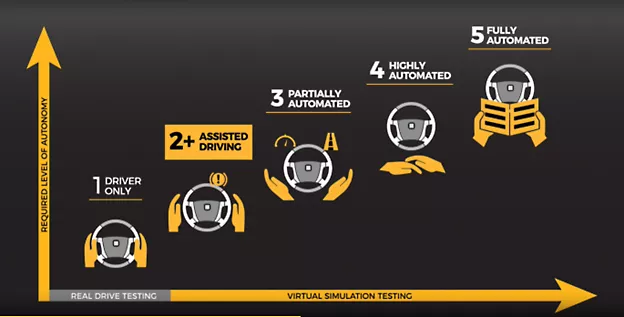
The trend is shifting from distributed ADAS electronic controller units (ECUs) to a more integrated ADAS domain controller with centralized ECUs. This means that we are currently at what SAE International designates as Level 2 (Partial Driving Automation), where the vehicle can control both steering and accelerating/decelerating but falls short of self-driving because a human sits in the driver’s seat and can take control of the car at any time.
Conclusion
Advanced Driver Assistance Systems (ADAS) play a crucial role in enhancing vehicle and road safety by using automated technologies to assist drivers in preventing accidents and reducing human error. These systems improve driving comfort and confidence by providing real-time warnings, corrective actions, and support for various driving tasks, ultimately contributing to safer roads and fewer collisions.