
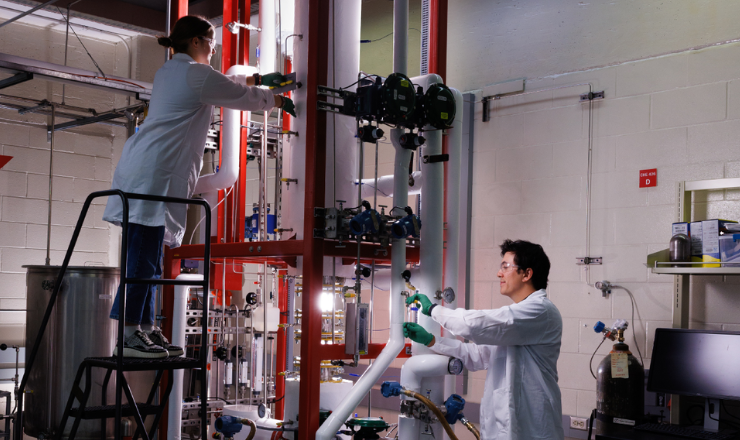
What is Chemical Engineering?
Chemical engineering is an engineering discipline that transforms raw materials into useful products. Examples of chemically-engineered products include antibiotics and vaccines, pharmaceuticals, clean water, fuels, fertilizers, adhesives, fabrics, catalytic converters, electronic chips and batteries.
Chemical engineers design and develop chemical processes to make these products on a manufacturing scale that are efficient, cost-effective, safe, and environmentally responsible. To achieve these goals, chemical engineers apply their knowledge and skills in math, economics and sciences (in particular, chemistry.)
What Do Chemical Engineers Do?
Graduates with a chemical engineering degree have a wide range of career opportunities. Many go on to work in industries like energy, pharmaceuticals, environmental engineering, food production and materials science. Others pursue advanced degrees in engineering, business or medicine.
Here are just a few career paths you could take with a chemical engineering degree:
- Process Engineer : Design, implement and optimize industrial processes in sectors like oil refining, chemical manufacturing or food production.
- Pharmaceutical Engineer: Develop and scale production of medications, ensuring quality and compliance with regulations.
- Environmental Engineer: Address sustainability challenges through pollution control, waste management and clean energy innovation.
- Materials Scientist: Create and test new materials used in products ranging from electronics to sustainable packaging.
- Safety Engineer: Monitor and improve workplace safety in chemical plants and production facilities.
- Technical Consultant: Advise companies on process improvements, environmental compliance or product development.
What Do Chemical Engineering Majors Learn?
Students across the globe follow a remarkably similar learning journey, which cover the following core elements:
- Foundations: thermodynamics, fluid mechanics, heat and mass transfer.
- Reactions & transport: chemical reaction engineering and transport phenomena.
- Separations & control: distillation, membranes, crystallisation, and process control.
- Design & safety: turning unit operations into flowsheets, quantifying hazards, and making sustainable choices.
Upper-level elective and required courses in the Chemical Engineering major include classes such as:
- Chemical Reaction Engineering
- Heat and Mass Transfer
- Process Fluid Transport
- Chemical Process Dynamics and Control
- Chemical Plant Design
- Separation Processes
- Materials Science & Engineering
- Biochemical Engineering
- Polymer Engineering
- Engineering Clinic (I-VIII, project-based coursework)
- Process Safety
- Air Pollution Control and Environmental Engineering
- Process Design Principles

Chemical Engineering Clinic
linic offers continual active learning through engineering and research projects with faculty. The projects, often industry driven, enable students to tackle open ended challenges and real-world issues. In Clinic, an interdisciplinary team of student engineers collaborate to work together toward a solution.
- Biomedical Engineering
- Chemical Engineering
- Civil Engineering
- Computer Engineering
- Construction Management
- Electrical Engineering
- Engineering Entrepreneurship
- Environmental Engineering
- Mechanical Engineering

Chemical Engineering Principles Explained
Thermodynamics – Governing Energy and Equilibria
Thermodynamics is the backbone of chemical engineering. It defines how energy is stored, transferred, and transformed in physical systems, and sets the limits for what is achievable in any process.
In chemical engineering, thermodynamics is used to:
- Establish chemical equilibrium conditions
- Predict phase changes (e.g., boiling, condensation, melting)
- Analyze energy efficiency of processes
- Determine heat requirements and work output
Engineers rely on the laws of thermodynamics to design systems such as:
- Distillation columns (based on vapor–liquid equilibrium)
- Heat exchangers (based on energy conservation)
- Reactors (considering enthalpy and Gibbs free energy)
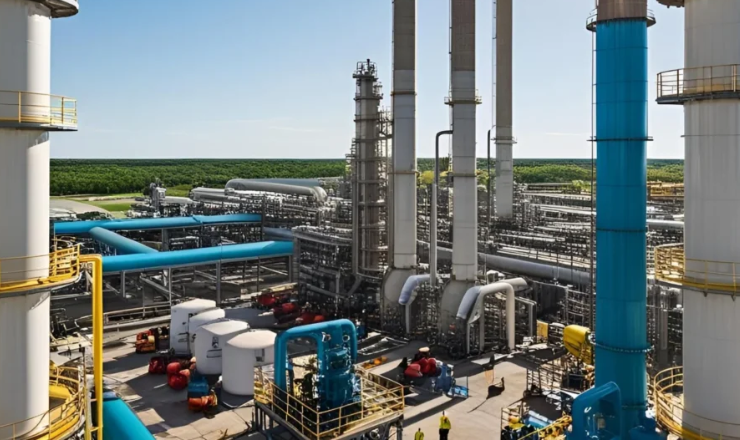
Fluid Mechanics – Describing Flow and Pressure
- Fluid mechanics is one of the core chemical engineering principles.
- It explains how liquids and gases behave when flowing through pipes, valves, tanks, and process equipment.
- This principle is critical for designing reliable and efficient systems that transport fluids under controlled pressure and flow conditions.
Chemical engineers apply fluid mechanics to solve practical problems such as:
- Calculating pressure drop across a pipeline
- Determining the required pump power
- Evaluating whether flow is laminar or turbulent
- Understanding how fittings and valves affect system behavior
Key concepts include:
- Continuity equation (mass balance)
- Bernoulli’s equation (energy conservation in flow)
- Reynolds number (to characterize flow regimes)
- Head loss and friction factors (for pressure losses)
Among chemical engineering principles, fluid mechanics plays a unique role in connecting theoretical models to equipment sizing and plant layout. Every process that involves flow—whether gas or liquid—relies on these calculations.
Phase Equilibria
Phase equilibria are essential chemical engineering principles that describe how substances distribute among different phases liquid, vapor, or solid under varying temperature and pressure conditions. These principles are foundational to all separation processes, from simple vaporization to complex multi-stage distillation systems.
Engineers use phase equilibrium data to:
- Define boiling and dew points for mixtures
- Predict component distribution in vapor
- liquid or liquid–liquid systems
- Establish the feasibility and efficiency of separations
- Design energy-efficient operations
Mass and Energy Balances
Mass and energy balances are fundamental chemical engineering principles that ensure every input, output, accumulation, and transformation within a system is accounted for.
These balances form the quantitative foundation of all process design, analysis, and optimization activities.
A mass balance ensures that the total mass entering a system equals the mass leaving, plus any accumulation or consumption. Similarly, an energy balance ensures that energy is conserved, whether in the form of heat, work, or internal energy.
Chemical engineers apply these principles to:
- Design and scale up chemical reactors
- Analyze steady-state and transient operations
- Optimize resource use and minimize waste
- Establish utility and energy requirements
Chemical Kinetics – Rates and Mechanisms of Reactions
Chemical kinetics focuses on the rate at which chemical reactions occur and the mechanisms that govern them. Among the core chemical engineering principles, kinetics is essential for understanding how fast a process proceeds, how conditions affect reaction rates, and how to design efficient reactors.
Chemical engineers use kinetics to:
- Design and scale up chemical reactors
- Estimate conversion, selectivity, and yield
- Choose optimal temperature, pressure, and residence time
- Assess safety margins for exothermic or runaway reactions
Process Control
Process control is the branch of chemical engineering that deals with regulating system variables, such as temperature, pressure, flow, and composition, to ensure stable, safe, and efficient operation.
It is one of the most practical chemical engineering principles, bridging theoretical models with real-time plant performance.
Chemical engineers apply process control to:
- Stabilize continuous production systems
- Prevent dangerous deviations (e.g., temperature runaways)
- Automate complex operations
- Integrate safety systems and alarms
In modern chemical plants, process control is inseparable from daily operations. It ensures that the other chemical engineering principles, such as thermodynamics, fluid dynamics, and kinetics, can be applied reliably and consistently under variable conditions.
Heat Transfer – Understanding Thermal Energy Flow
Heat transfer is a core chemical engineering principle that explains how thermal energy moves within and between materials. It is essential for the design of heat exchangers, reactors, distillation columns, evaporators, and any unit where temperature control is critical.
Engineers use heat transfer principles to:
- Size exchangers for heating/cooling duties
- Analyze temperature profiles in equipment
- Prevent hotspots and thermal degradation
- Integrate energy recovery and efficiency
Understanding heat transfer enables safe, energy-efficient, and optimal thermal control across all unit operations.
Conclusion
Chemical engineering is undergoing a profound transformation. Process Intensification offers not just better performance, but a reimagining of how we design and operate chemical plants smaller, safer, cleaner, and faster. But to make the most of this opportunity, engineers need more than new hardware they need integrated digital tools, simulation platforms, and AI support.