
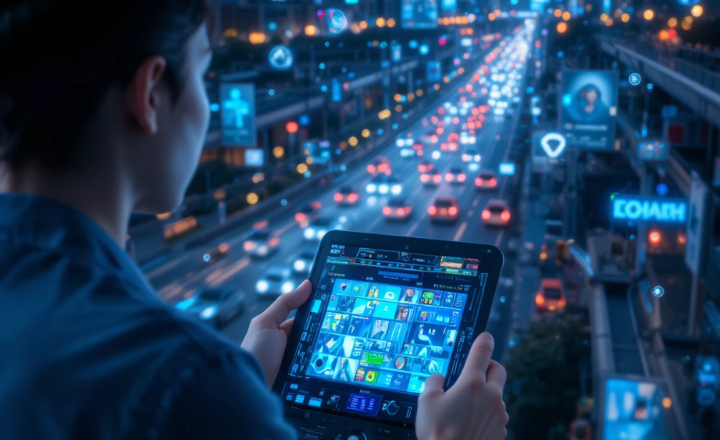
Traffic congestion has become one of the major challenges in modern cities. Long waits, accidents, and increased fuel consumption are all consequences of the growing number of cars on the road due to urban population growth.
Fixed timer-based traditional traffic control techniques are no longer adequate.
A Smart Traffic Management System an intelligent and automated solution to monitor, control, and optimise traffic flow in real-time is being designed using IoT (Internet of Things) technology to address these problems.
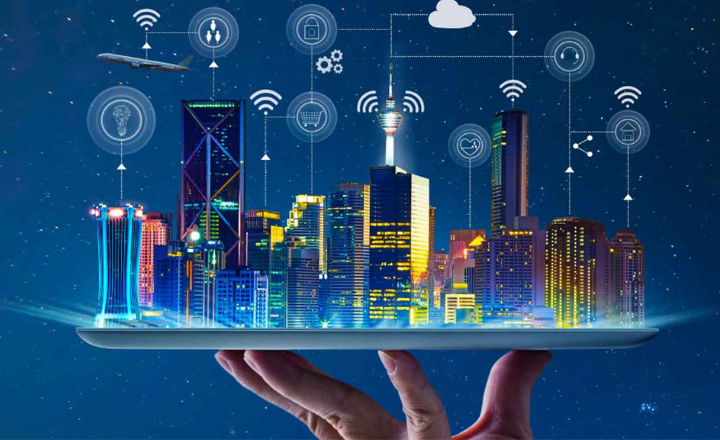
Application of IoT in Traffic Management
City governments can improve their operations & infrastructure by placing IoT sensors and tracking devices on roads and highways for recording, analyzing, and sharing data in real-time.
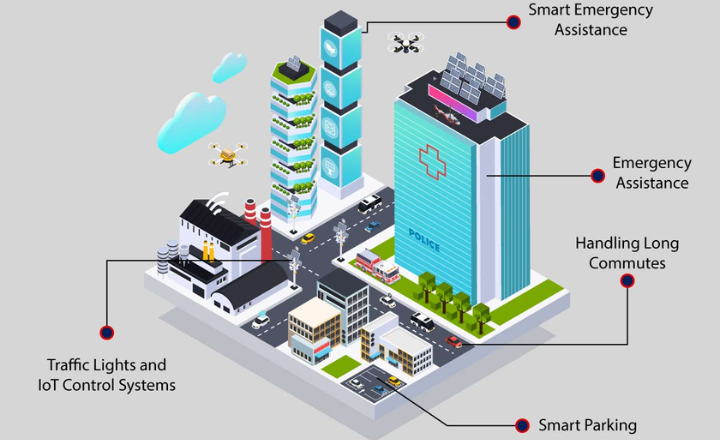
An intelligent traffic monitoring system using IoT capabilities has so many factors & use cases, including;
- Traffic Lights and IoT Control Systems: Smart traffic signals may look like a typical stoplight, yet they utilize an array of sensors to monitor real-time traffic. Usually, the goal is to help cars reduce the amount of time spent idle. And IoT technology enables the various signals to communicate with each other. This is while adapting to changing traffic conditions in real time.
- Parking Enabled through IoT: Smart meters and mobile apps make on-street parking spaces easily accessible with instant notifications. Drivers receive alerts whenever a parking spot is available to reserve it instantly. The app gives easy directions to the parking spot with a convenient online payment option.
- Emergency Assistance through IoT: A traffic monitoring system using IoT technology enables emergency responders to speed up the care mechanism in case of accidents late at night or in isolated locations.
- When an accident is detected by road sensors, the traffic management system is notified right away. This request is forwarded to the appropriate authorities for remedial action.
- Emergency response personnel would include medical technicians, police officers, and fire departments for enhanced responsiveness and timely intervention.
- Commute Assistance: With every vehicle acting as an IoT sensor, a dedicated app can make suggestions, determine optimal routes & provide advance notice of accidents or traffic jams. Further, it can even suggest the best time to leave. It is all because of a robust algorithm that helps reduce driving time with intelligent traffic lights.
Functioning of Traffic Monitoring System Using IoT Capabilities
This intelligent system comprises several components, including wireless sensors, RFID tags, and BLE beacons installed at the traffic signals to monitor the movement of vehicles.
A real-time data analytics tool connects the Geographic Information System (GIS-enabled) digital roadmap with control rooms for real-time traffic monitoring.
The smart traffic management system captures the images of vehicles at the signals using the digital image processing technique. This data is then transferred to the control room via wireless sensors.
The system also leverages BLE beacons or RFID tags to track the movement of vehicles and keep traffic congestion in control, track down stolen vehicles and even clear the road for emergency vehicles that are installed with RFID readers.
System Components
A smart traffic management system using IoT consists of the following key components:
- Sensors:
- Infrared (IR) sensors or ultrasonic sensors detect vehicle presence and count vehicles.
- Inductive loop sensors can be installed under roads to monitor traffic density.
- Microcontroller:
- An Arduino, Raspberry Pi, or ESP32 acts as the main controller that processes data from sensors.
- An Arduino, Raspberry Pi, or ESP32 acts as the main controller that processes data from sensors.
- Communication Module:
- Wi-Fi, GSM, or LoRa modules are used to send real-time traffic data to the central server or cloud platform.
- Wi-Fi, GSM, or LoRa modules are used to send real-time traffic data to the central server or cloud platform.
- Cloud Server / IoT Platform:
- Platforms like ThingSpeak, AWS IoT, or Google Cloud IoT store and analyze traffic data.
- Platforms like ThingSpeak, AWS IoT, or Google Cloud IoT store and analyze traffic data.
- Traffic Lights:
- Controlled dynamically by the microcontroller based on the number of vehicles detected at each lane.
- Controlled dynamically by the microcontroller based on the number of vehicles detected at each lane.
- Web / Mobile Dashboard:
Displays live traffic conditions and allows authorities to control signals remotely.
Key Features of a Smart Traffic Management System
The key features are listed below depending on the city’s size and the scope of the governmental policies. It can be integrated into an intelligent traffic management system.
They include:
- Traffic Jam Detection: With cloud connectivity, sensors, and CCTV cameras tracking intersections 24×7, technicians can remotely monitor all the streets in real-time from the city’s traffic control room.
- Connected Vehicles: A smart traffic system using IoT technology can connect with roadside tracking devices to enable direct communication between intelligent vehicles & intersections.
- Modular Control: Real-time detection of congestion triggers dynamic adjustments in the systems meant for controlling traffic lights, express lanes, and entry alarms.
- Emergency Navigation: A system with edge data processing & programmatic alerting capabilities can alert response units (police, ambulance & tow trucks) in case of a car crash or collision. It reduces the crucial time an injured driver or passenger remains unattended.
- Road Safety Analytics: Systems with pattern detection capabilities can immediately flag high cruising speeds and reckless driver or inappropriate pedestrian behavior.
- Digital Payments: Commercial traffic management systems enable quick and convenient electronic transactions in real time while ensuring financial data safety.
Working Principle
A basic architecture that serves as a launchpad for feature enhancements and service upgrades will integrate the following components:
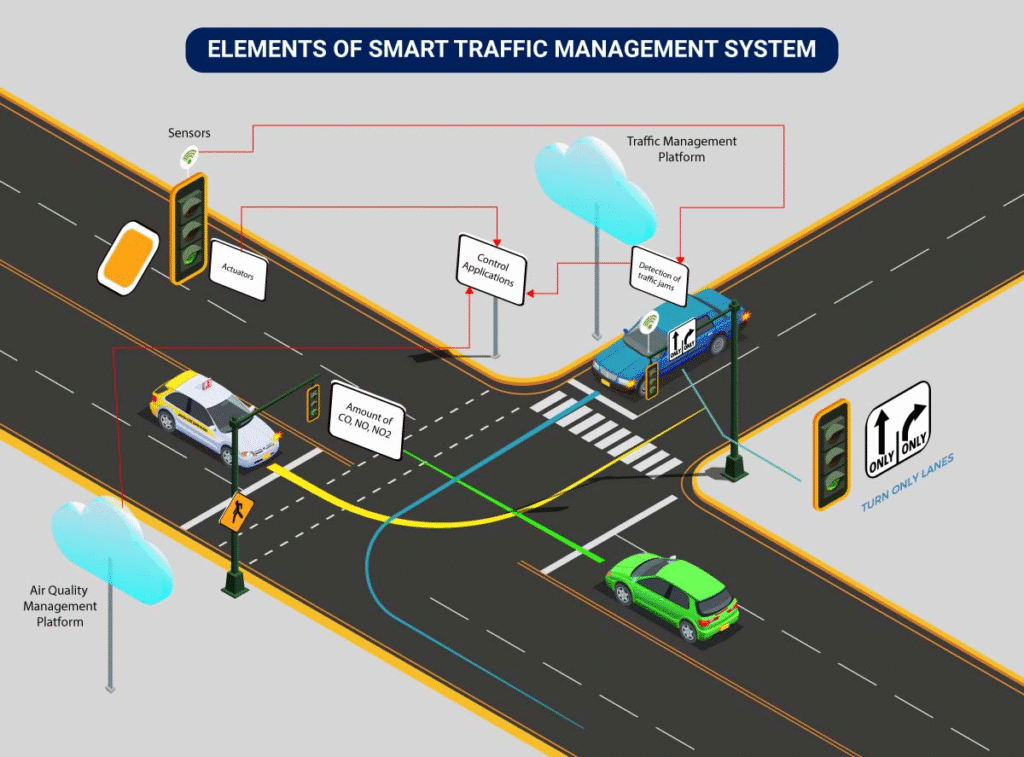
- Sensors for collecting data and sending it to a centralized cloud platform
- Actuators for physical devices to make necessary adjustments like – restricting the water supply in pipelines with leakages or dimming & brightening streetlights based on weather conditions.
- Field gateways to collect & compress data before moving it to a cloud platform.
- Cloud gateways enable secure data transfer between field gateways & the cloud storage of the traffic management system
- A data lake to store the raw, unstructured information before it is cleansed, processed, transformed & moved to a data warehouse for extracting actionable insights.
- Data warehouse stores contextual information about connected objects and devices installed with sensors and actuators.
- Data analytics for analyzing the data from streetlight sensors on a centralized dashboard to adjust the intensity of lights
- ML algorithms to analyze traffic patterns & trends from historical data – stored in the data warehouse. The identified trends are then used to build predictive models for control apps. These apps modify the average vehicle speed to avoid congestion.
- Rules to enable actuators to automate the functioning & control of smart city objects and devices. These rules are manually defined to tell actuators what needs to be done to solve a specific problem.
- User applications that allow citizens to receive instant notifications in case of traffic jams and congested routes. Desktop user apps for control rooms send commands to actuators for altering traffic signals. It helps to relieve congestion and optimize routes.
- Cross-solution integrations with traffic lights or streetlight management systems. Control apps apply ML models or predefined rules to prompt appropriate output action if the air quality is poor.
Cities of all sizes can leverage this approach. Depending on the budgetary and procurement constraints, they can start small. It would be with solutions like a littering offense ticketing system or a smart parking app. Later they can expand the range of services.
Advantages of a Smart Traffic Management System
Cleaner, greener, safer, and more accessible roads are a few benefits of implementing IoT and intelligent technology.
- Reducing traffic jams and accidents on the streets
- Ensuring immediate clearance for emergency vehicles
- Facilitating safer and shorter commute times
- Reducing congestion & energy consumption at intersections
- Offering significant productivity benefits with real-time monitoring of crucial infrastructures
- Reducing operating costs with efficient traffic management processes
- Ensuring compliance with the regulations for reducing the carbon footprint
- Saving billions of gallons of fuel wasted every year
- Accurate tracking & quick recovery of lost and stolen vehicles
Disadvantages
- High Initial Cost: Installation of sensors and IoT infrastructure can be expensive.
- Maintenance Issues: Sensors and devices require regular calibration and repair.
- Data Security Concerns: IoT systems are vulnerable to cyberattacks if not protected properly.
- Power Dependency: Continuous power supply is necessary for sensors and controllers.
Conclusion
The Smart Traffic Management System using IoT is an innovative step toward building intelligent and sustainable cities. By integrating sensors, IoT platforms, and data analytics, this system can significantly improve road safety, reduce congestion, and save energy. Although initial implementation costs are high, the long term benefits in terms of efficiency, safety, and sustainability make it a promising solution for modern transportation challenges.