

A leveling staff is a crucial instrument in surveying, consisting of a straight, rectangular rod typically made of wood or modern composite materials. It is precisely graduated into metric or imperial units, with meters or feet as the primary divisions, further subdivided into smaller increments for accurate measurements.
When observed through a leveling instrument, the line of sight touches the staff at a particular point, offering a reading that indicates the height of the instrument’s line of sight concerning the point on the ground where the staff is stationed.
To accommodate diverse surveying requirements and circumstances, leveling personnel are available in a variety of configurations. They are essential tools in a variety of fields, from topographic mapping and geological research to construction and civil engineering, due to their precision and simplicity of use.
A Type of Leveling Staff ability to work depends on its distinct, contrasting graduations, which are clearly seen from a distance using a telescopic sight.
1. Self-reading staff
2. Target staff
Types of Leveling Staff
Self-reading Staff
A self-reading staff is one on which the observer can directly read measurements through the telescope without any intermediate steps. This type of staff allows for straightforward and efficient observation, eliminating the need for additional tools or personnel to record readings.
Self-reading staff are commonly used in leveling and surveying tasks due to their simplicity and ease of use.
Solid staff
Solid staffs are made as a single, continuous piece and are usually three meters long. Due to the absence of hinges or sockets, they offer greater accuracy in reading measurements, making them ideal for precise leveling tasks.
Solid staffs are predominantly used for specialized leveling work where precision is a priority, despite their practical limitations in terms of portability.
Solid staff” refers to a type of leveling staff used in surveying. Based on gathered information, a solid staff is typically a single, continuous piece of material, often around 3 meters in length, constructed without hinges or joints. It offers greater accuracy because of its rigidity and the absence of joints that could introduce measurement errors.
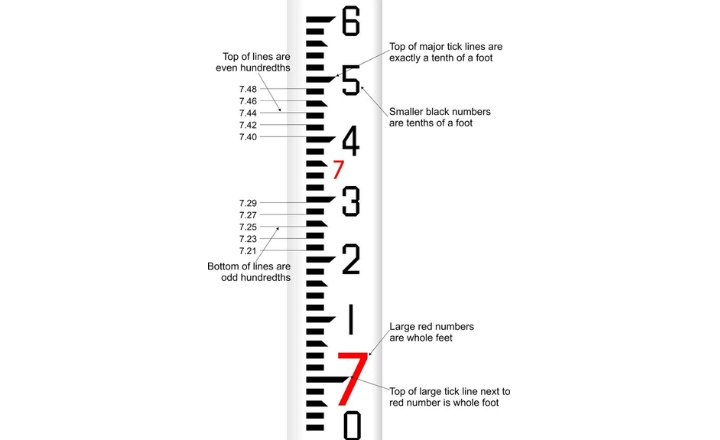
Folding or hinged staff
A folding or hinged staff is a type of leveling staff used in surveying. It is typically constructed from well-seasoned timber for durability and precision, measuring about 4 meters in total length and consisting of two 2-meter sections connected by a hinge.
The staff generally has a width of 75 mm and a thickness of 18 mm, with a brass cap on the foot to protect it from wear. Some versions include a plummet to help maintain verticality during measurements.
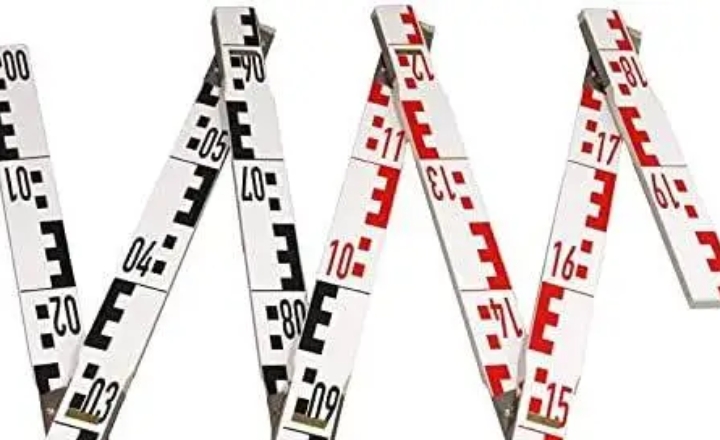
Modern leveling staffs feature upright graduations for easier reading.
When not in use, the staff can be folded for convenience, offering several practical configurations:
- One 2-meter section can fold onto the other, making it compact and easier to carry.
- The two sections can be detached, allowing the use of a single 2-meter piece in flat or plain areas.
- When the sections are locked together, the staff functions as a single, rigid rod for accurate leveling tasks.
Telescopic or Sopwith-Type Staff
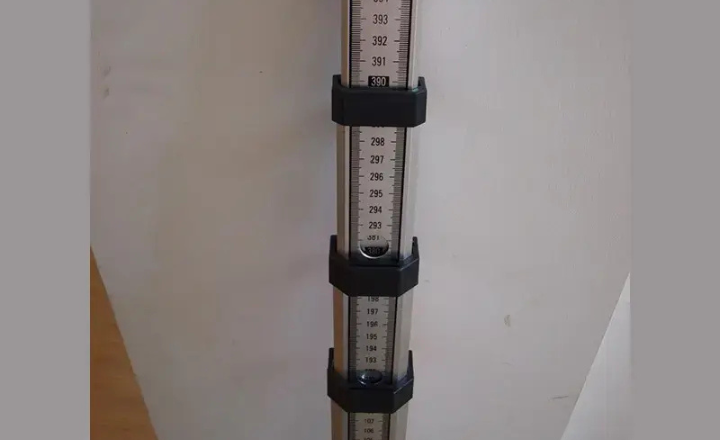
A telescopic or Sopwith-type staff is a surveying leveling staff made of three interlocking sections that slide into each other, allowing the staff to collapse for easy transport and extend to full length during use.
The smallest division on this leveling staff is 5 mm. Meter numerals, located on the left side, are marked in red, while decimeter numerals (1 to 9) are displayed on the right side and marked in black. The numeral 10 is replaced by the letter “M” to indicate the end of each meter length. Graduations are marked upright, although they appear inverted when viewed through a telescope.
When using the telescopic staff, it’s crucial to ensure that all three sections are fully extended to utilize the complete 4-meter length accurately.
Target Staff
A target staff is a type of leveling staff used in surveying, similar to a self-reading staff but equipped with a movable target. The target is typically circular or oval, painted red and white in alternate quadrants, and fitted with a vernier at its center for precise reading.
During use, the instrument operator instructs the person holding the target staff to move the target up or down until its center aligns with the instrument’s horizontal line of sight. This method provides greater accuracy and ease of reading over long distances compared to traditional self-reading staff.
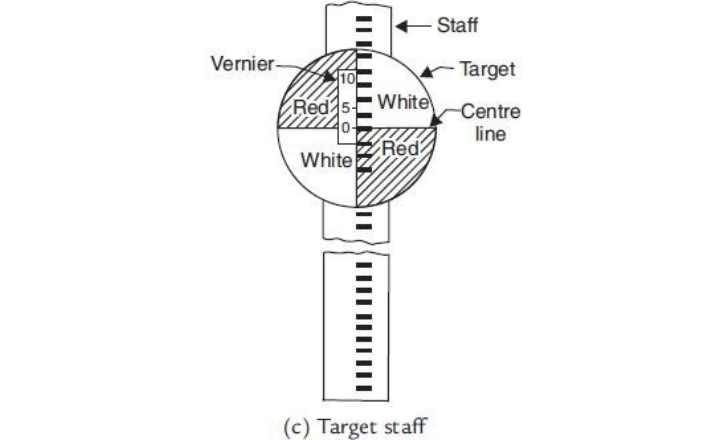
The target staff often consists of two sections; an upper rod slides into a lower rod, allowing length adjustment. The graduations are marked clearly to aid in precise leveling measurements and can be in metric or imperial units.