
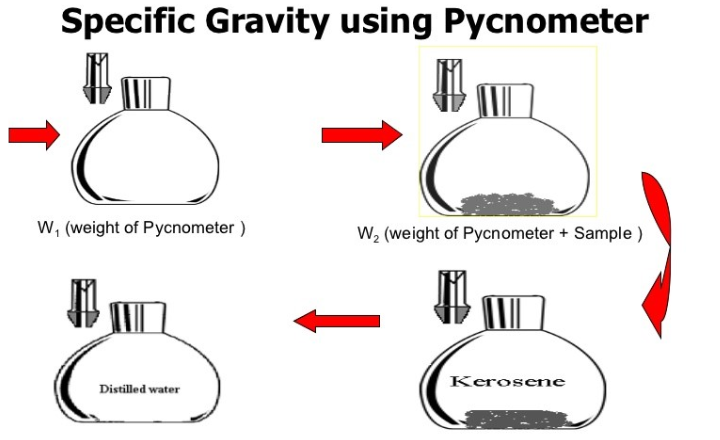
The Determination of Soil Specific Gravity Using the Pycnometer Method stands out as a reliable technique for determining soil specific gravity, a key factor influencing structural integrity.
- The pycnometer method is suitable for both fine-grained and coarse-grained soils. It involves placing a known mass of oven-dried soil into a pycnometer (a glass container of known volume), filling the pycnometer with de-aired water to completely cover the soil, removing entrapped air using shaking and vacuum pumping, and weighing the filled pycnometer. The process includes careful steps to ensure accurate volume measurement and elimination of air bubbles, which could affect results.
- The specific gravity GGG is then calculated using the masses of the empty pycnometer, the pycnometer with soil, the pycnometer with soil and water, and the pycnometer filled with water. This technique is similar to the density bottle method but uses a larger volume of soil to increase accuracy. The temperature of the water is also recorded since water density changes with temperature, affecting the results.
Theory
Theory
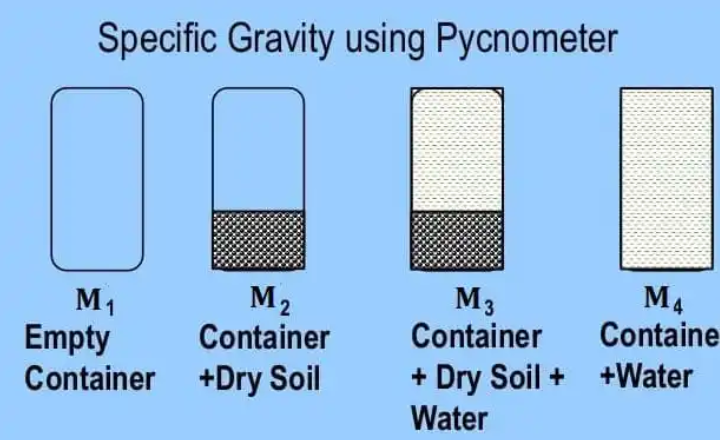
The pycnometer method is based on the principle of comparing the mass of a known volume of soil with the mass of an equivalent volume of water. The specific gravity (G) of the soil is calculated using the relation:
G = M2 – M1/(M2 – M1) + (M3 – M4)
Where:
M1 is the mass of the empty pycnometer.
M2 is the mass of the pycnometer filled with oven-dried soil.
M3 is the mass of the pycnometer containing the soil and water.
M4 is the mass of the pycnometer completely filled with water only.
Equipment and Apparatus
The equipment and apparatus used for determining soil specific gravity using the pycnometer method include: a pycnometer (a 1-liter glass jar with a screw-type brass conical cap sealed to prevent leakage), a precise weighing balance, distilled water, and a glass rod. The pycnometer is filled with a known dry soil sample and water, sealed, and weighed at different stages to calculate specific gravity. Additionally, a vacuum pump may be used to remove air bubbles from the soil-water mixture for accuracy. This setup ensures precise measurement of soil particle density in relation to water.
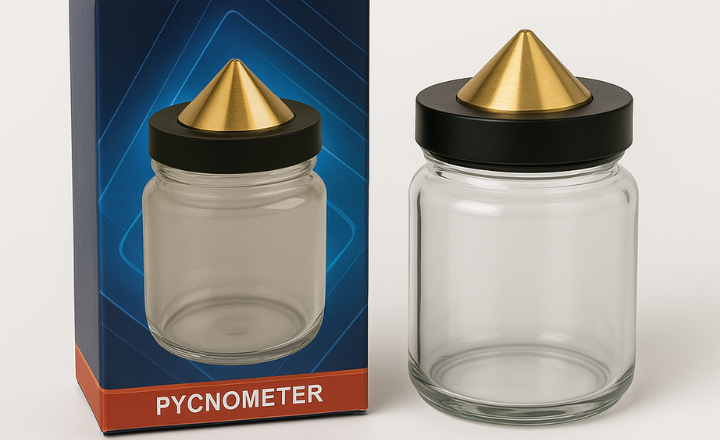
- Pycnometer: A glass jar of about 1 liter capacity fitted with a conical brass cap that has a small 6 mm diameter hole. The cap is provided with a washer to ensure no leakage, and marks on the cap and pycnometer ensure consistency in filling.
- Weighing Balance: Accurate to at least 1 gram.
- Glass Rod: For shaking the contents.
- Vacuum Pump: Used to remove entrapped air from the soil-water mixture.
- Oven: For drying the soil sample.
Procedure Used in Determination of Soil Specific Gravity Using the Pycnometer Method
Clean and weigh the empty pycnometer; add a known mass of oven-dried soil to it and record the weight. Add de-aired water to cover the soil, shake, apply a vacuum to remove air bubbles, then fill to the calibration mark and weigh. Finally, weigh the pycnometer filled with water only and use these weights to calculate the specific gravity of the soil.
Preparation
- Weigh the empty, clean, and dry pycnometer with its stopper accurately.
- Add a known mass of oven-dried soil to the pycnometer and weigh it again.
- Fill the pycnometer partially with de-aired water, agitate well, apply a vacuum to remove air bubbles, then fill it to the mark, wipe dry, and weigh it.
- Screw the cap tightly and mark the cap and the pycnometer with a vertical line along their axes. This mark ensures that the cap is replaced in the same position each time, keeping the internal volume constant.
- Weigh the empty pycnometer (record this as M1) to the nearest 0.1 g.
Soil Sample Preparation
- Oven-dry the soil sample and cool it to room temperature.
- Place approximately 200–300 grams of the oven-dried soil into the clean, dry pycnometer.
- Replace and tighten the cap, then weigh the pycnometer with the dry soil (record as M2).
Adding Water
- Unscrew the cap of the pycnometer containing dry soil and add a sufficient amount of de-aired water to cover the soil completely.
- Reattach the cap securely to ensure no water leakage.
- Shake the pycnometer thoroughly using a glass rod, then connect it to a vacuum pump to remove entrapped air. Maintain the vacuum for approximately 10–20 minutes, depending on the soil type, ensuring that no air bubbles remain.
Removing Entrapped Air
- Subject the soil-water mixture in the pycnometer to a partial vacuum using a vacuum pump or aspirator to remove entrapped air, gently agitating periodically; this process may take 2-8 hours depending on soil type.
- After removal of entrapped air, cool the pycnometer to room temperature before proceeding with the next steps of the test.
- Shake the pycnometer thoroughly using the glass rod.
- Reapply the vacuum for an additional 5 minutes until no air bubbles emerge from the water.
Final Weighing
- Fill the pycnometer with water up to the calibration mark after removing air bubbles using a vacuum pump.
- Dry the exterior of the pycnometer carefully to ensure no extra weight from moisture.
- Weigh the filled pycnometer accurately and record this mass for calculation purposes.
- Record the temperature of the contents for accuracy, as temperature variations can affect the density of water.
Water Calibration
- Emptying and cleaning the pycnometer thoroughly.
- Filling the pycnometer with distilled water up to the calibration mark, ensuring the cap is screwed on to the same marked position.
- Drying the outside and weighing the pycnometer filled with water to record the water-only mass for precise volume calibration.
- Empty the pycnometer, wash, and dry it.
- Fill it with water only, screw the cap to the mark, dry the exterior, and weigh it (record this as M4).
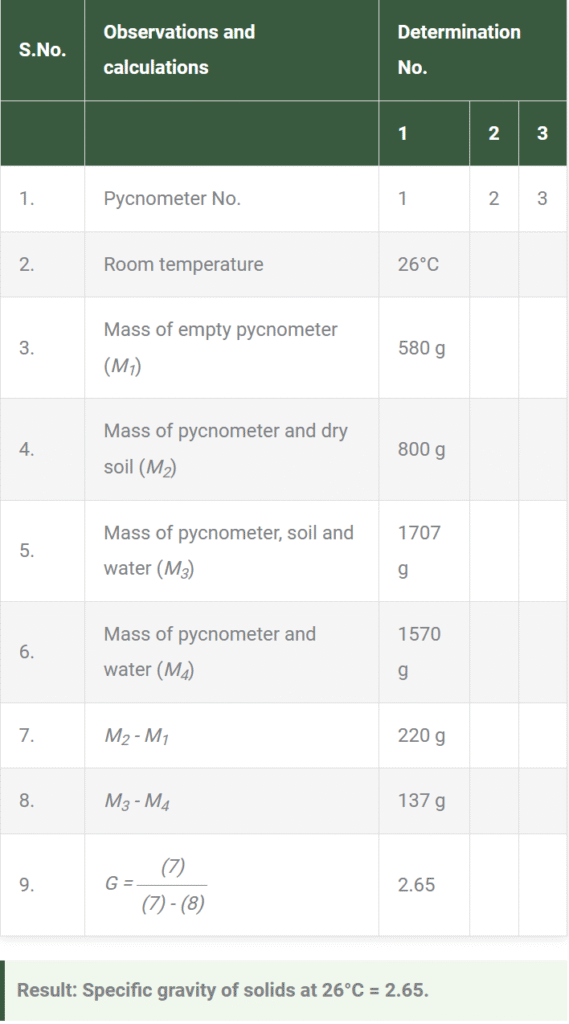
Observations and Data Recording for Specific Gravity by Pycnometer Metho:
Precautions for Determination of Soil Specific Gravity Using the Pycnometer Method
- Ensure the soil sample is completely dry and free from lumps; if lumps form during drying, break them down to their original size to avoid errors.
- Eliminate entrapped air from the soil-water mixture by using a vacuum pump and thorough shaking, as trapped air leads to inaccuracies.
- Clean and dry the pycnometer thoroughly before and after each use to prevent contamination that could affect weight measurements.
- Record the temperature of the water during measurement, as specific gravity values can vary with changes in temperature.
- Sample Preparation: The soil sample must be completely free from lumps. If lumps are present, they should be broken down to maintain consistency.
- Entrapped Air: Ensure that all entrapped air is removed using the vacuum pump, as trapped air bubbles can cause errors in the measurement.
- Weighing Accuracy: Use a well-calibrated weighing balance and check its accuracy before starting the test.
- Consistent Volume: Ensure the pycnometer is always filled to the calibration mark for consistent volume during each weighing.
- Temperature Control: Record the temperature of the water/soil mixture, as water density is temperature-dependent.
Conclusion
The pycnometer method is a reliable laboratory technique for determining the specific gravity of soil particles. By carefully following the procedure and taking the necessary precautions, accurate measurements can be achieved. Understanding this method is crucial for further analyses in soil mechanics, such as calculating the void ratio and degree of saturation. This article aims to provide a clear and comprehensive guide for students and practitioners in the field.